



Retail pricing today runs on massive data volumes and thin margins, and manual or spreadsheet-based decisions can’t keep pace with either. Additionally, it isn’t easy to replace the legacy rule-based systems with a solution that optimizes for what you want based on the targets you would like to achieve.
Solving that engineering problem to get from your company targets to millions of product decisions is what a production-grade system requires. 7Learnings’ technology stack is built to do exactly that.
Data connections
To deliver accurate predictions, an optimization platform must integrate with existing retail ecosystems across all channels, such as online stores, physical locations, and mobile touchpoints.
This requires creating robust, standard inbound and outbound data connections that can handle high-frequency data transfers without disrupting the retailer’s core operations and support a truly omnichannel experience.
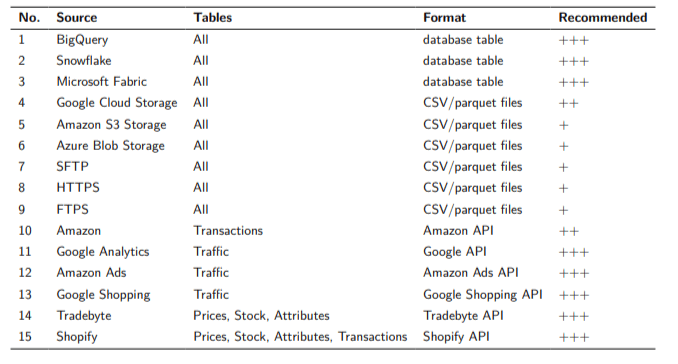
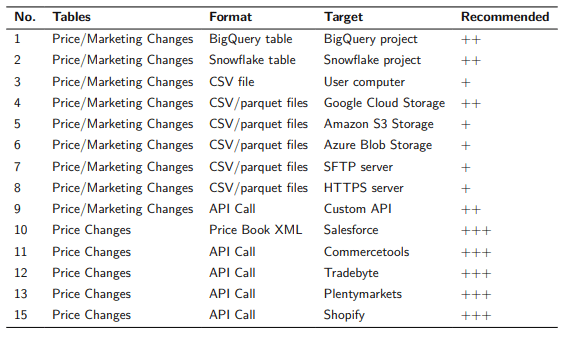
7Learnings has developed standard inbound connections to ingest critical retail data points from across your digital experience, such as historical sales, inventory levels, product metadata, competitor pricing, and marketing spend. These integrations include:
Once optimizations are calculated, they must be pushed back into the retailer’s operational systems instantly. 7Learnings has developed outbound connections to feed optimized prices and demand forecasting directly into:
Data cleaning
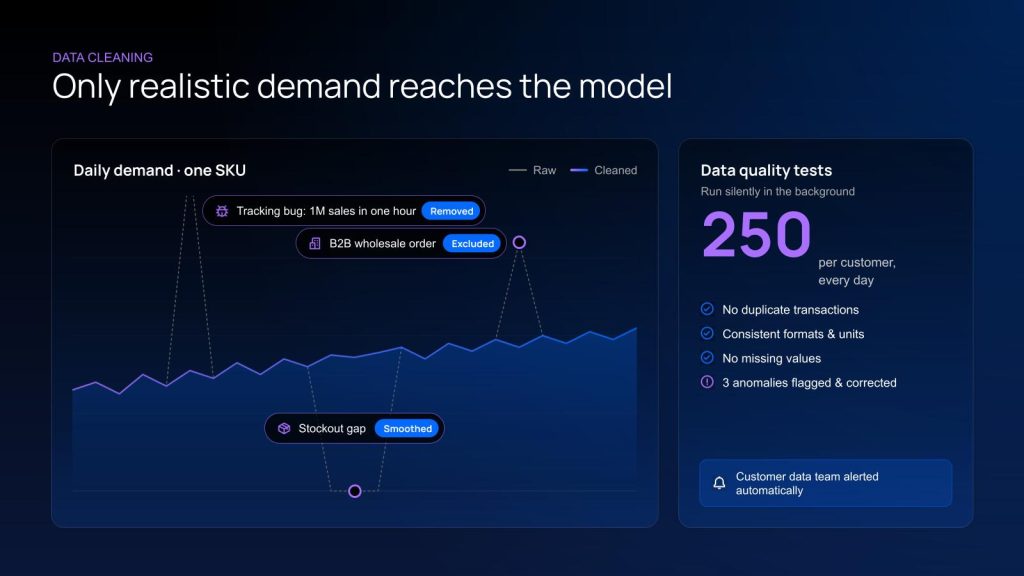
Raw company data frequently contains missing values, duplicate entries, skewed historical anomalies (like a tracking bug that accidentally recorded a million sales in one hour), and inconsistent formatting. If this “dirty” data reaches the machine learning models, the forecasts will be highly inaccurate.
To combat this, the 7Learnings platform features automated data cleaning driven by constant data tests that run silently in the background. The system automatically identifies, flags, and corrects anomalies.
For instance, it can detect artificial demand spikes caused by wholesale B2B orders or smooth out gaps caused by system stockouts, ensuring that the machine learning models train only on high-quality, realistic representations of retail demand.
We are currently running 250 data quality tests for each customer every day that make sure all the new data we are getting is high quality. If there is a problem, the customer data team is alerted automatically.
Data abstraction
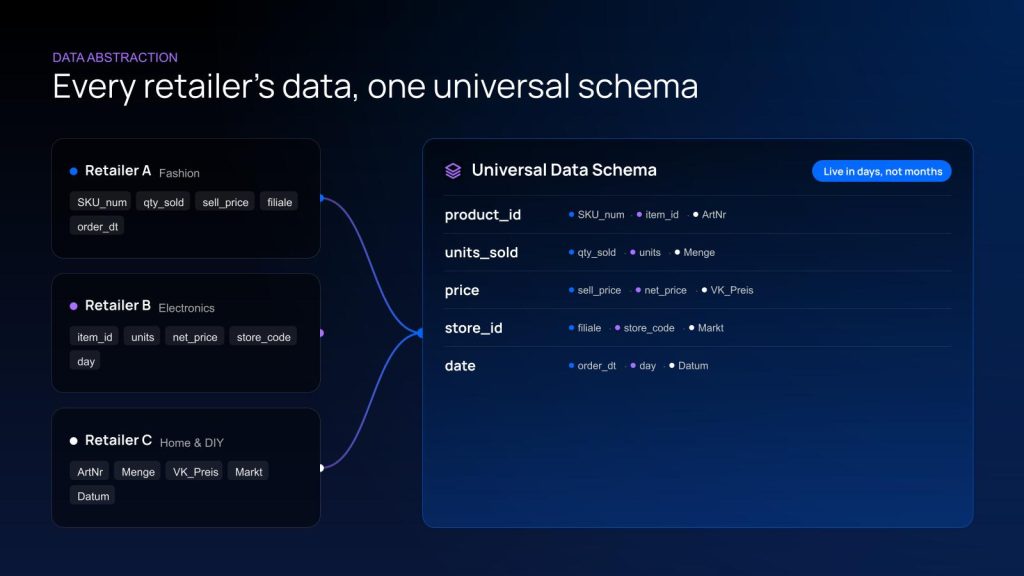
Every retailer structures their data differently. One company might label a product ID as SKU_num, while another calls it item_id. Any scalable artificial intelligence solution needs to ensure that data from entirely different companies looks the same to the machine learning models running on top of them.
7Learnings solves this by developing a Universal Data Schema. When data enters the 7Learnings pipeline, it goes through an abstraction layer that translates custom client structures into a unified format.
This abstraction allows 7Learnings to scale rapidly, deploy standardized models to new clients in days rather than months, and leverage aggregate, anonymous learning across the platform to improve baseline forecasting accuracy.
Data preparation
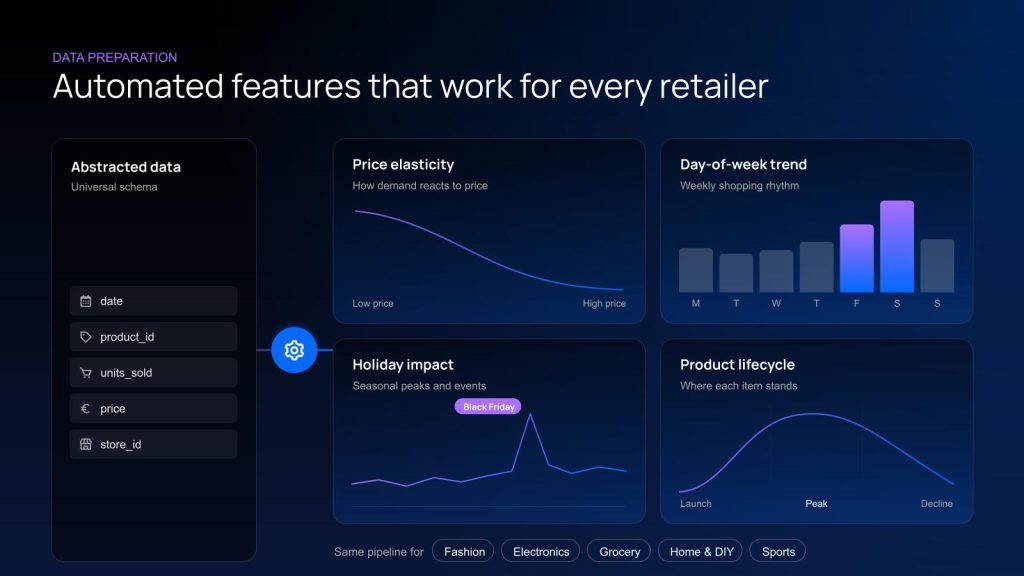
Once data is abstracted, it needs to be transformed into an optimal state for machine learning. This process, known as feature engineering, involves creating predictive variables (such as price-elasticity indicators, day-of-the-week trends, holiday impacts, or product-lifecycle stages).
The technical challenge is scalability. Custom feature engineering for every single client is a massive resource sink. 7Learnings addresses this by automating data preparation to generate features that work natively across many different customers.
Whether a retailer sells fashion apparel or consumer electronics, the data preparation pipeline automatically computes standardized, high-value features that capture generic retail dynamics, ensuring the AI can immediately pick up on underlying market signals.
Model standardization
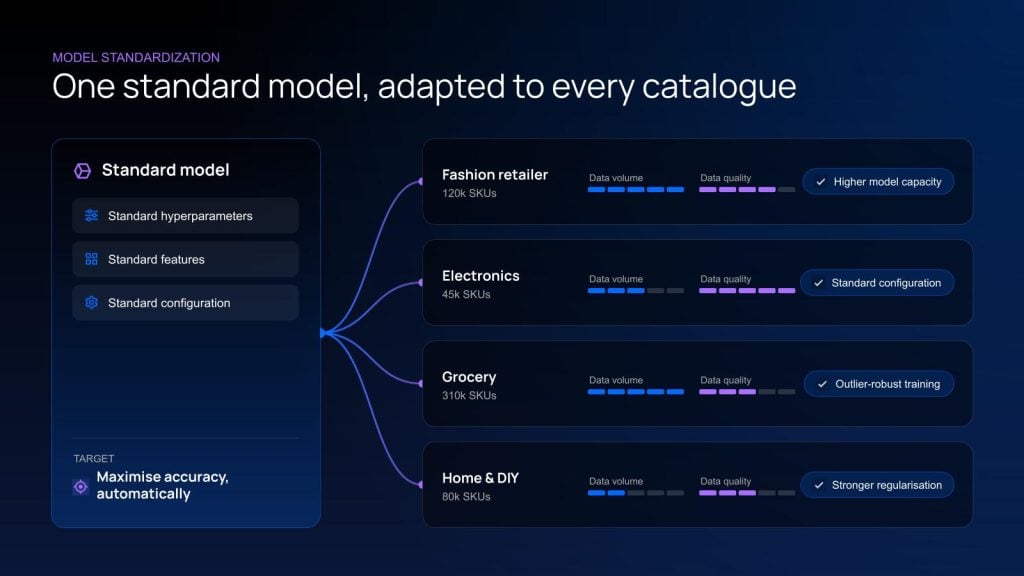
In traditional data science, models are meticulously hand-tuned by engineers for specific datasets. This bespoke approach fails when you are managing millions of product variations across dozens of enterprise clients.
To achieve true scalability, 7Learnings utilizes model standardization. We have defined machine learning models with standard hyperparameters, features, and configurations that dynamically adapt to each retailer’s data volume and quality. The target is to maximize model accuracy automatically.
By standardizing the model architecture, we can ensure elite-level predictive performance across diverse retail verticals without requiring a massive team of data scientists to manually tweak algorithms for every new catalog.
Forecast generation

The core of the technology stack lies in executing the actual forecast using predictive analytics. Calculating price elasticities and demand predictions at the individual product (SKU) level across hundreds of store locations or digital channels creates an astronomical number of data combinations.
At this scale, computing costs and processing time can skyrocket. 7Learnings generates these forecasts using a highly optimized pipeline that leverages parallel processing and cloud-native auto-scaling.
The resulting forecasts are compressed and saved using modern data storage techniques (such as columnar storage formats) that drastically minimize memory footprints and compute costs. This efficiency allows us to deliver ultra-precise forecasts without passing exorbitant cloud infrastructure bills down to our customers.
Retail forecasts need constant updates. New products launch and new sales post every day, so 7Learnings retrains the underlying machine learning models and updates forecasts daily.
Accuracy checking
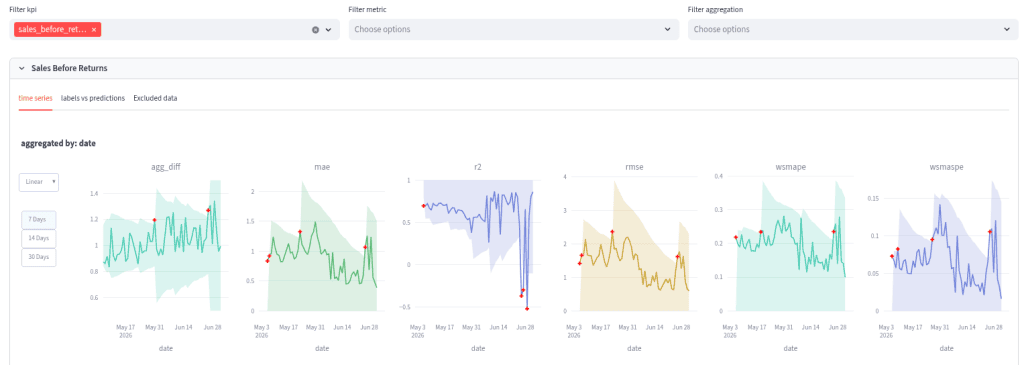
To ensure our models maintain peak predictive power and resist performance drift over time, 7Learnings implements an automated Accuracy Checking Pipeline driven by two core evaluation methods:
- The system simultaneously runs 30 distinct accuracy checking steps in parallel across cloud infrastructure. It stress-tests predictions at global, category, and SKU levels, measuring short-term vs. long-term time horizons using multiple error metrics (like WAPE and RMSE) to ensure robust validation.
- To track true accuracy, the pipeline regularly runs simulations where it rewinds the clock to a past date, completely hides the subsequent sales data from the model, and forces the AI to create a forecast for that past period.
Rule & target engine
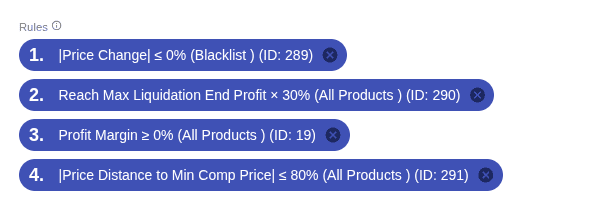
Pure AI recommendations are incredibly powerful, but they cannot run in a vacuum. Retail executives need to maintain strategic control over their business goals. That can mean clearing out winter inventory by a specific deadline, protecting brand image by maintaining a minimum margin, or matching a key competitor’s aggressive discounts.
7Learnings includes a robust Rule & Target Engine paired with an intuitive front-end interface. This enables business users to apply complex rules and commercial targets in a highly flexible way.
Users can set global constraints or drill down into specific product categories, combining the raw predictive power of the AI with the overarching strategic vision of the retail management team.
Optimization
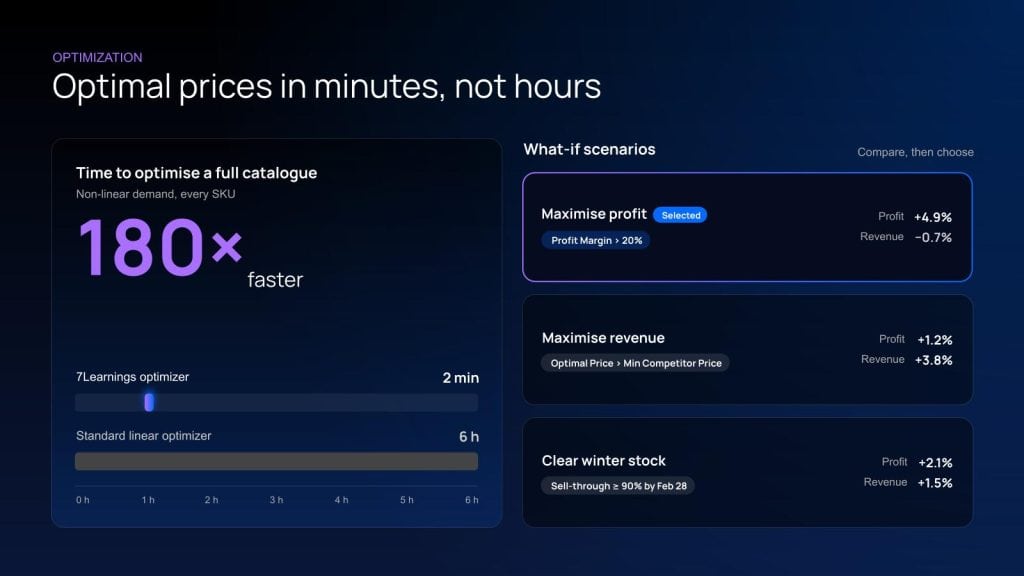
Predicting demand is only half the battle; the final step is translating those predictions into the exact prices or stock levels that will maximize business outcomes. This is where dynamic pricing and inventory management converge to solve massive, multi-variable mathematical optimization problems.
Standard linear optimization technologies often struggle with this, as retail demand curves are inherently non-linear and the sheer volume of SKUs can cause traditional solvers to stall. 7Learnings has developed a proprietary optimization technology designed specifically for retail dynamics.
Our optimization engine is significantly faster than standard linear optimization alternatives. (e.g., two minutes vs. six hours for a standard linear optimizer). This massive speed advantage changes the workflow for retail managers.
Instead of waiting hours for a single calculation, users can instantly run and compare multiple alternative “what-if” scenarios, tweak their targets, and confidently select the exact optimization strategy that best aligns with their business goals.
Enterprise-grade security
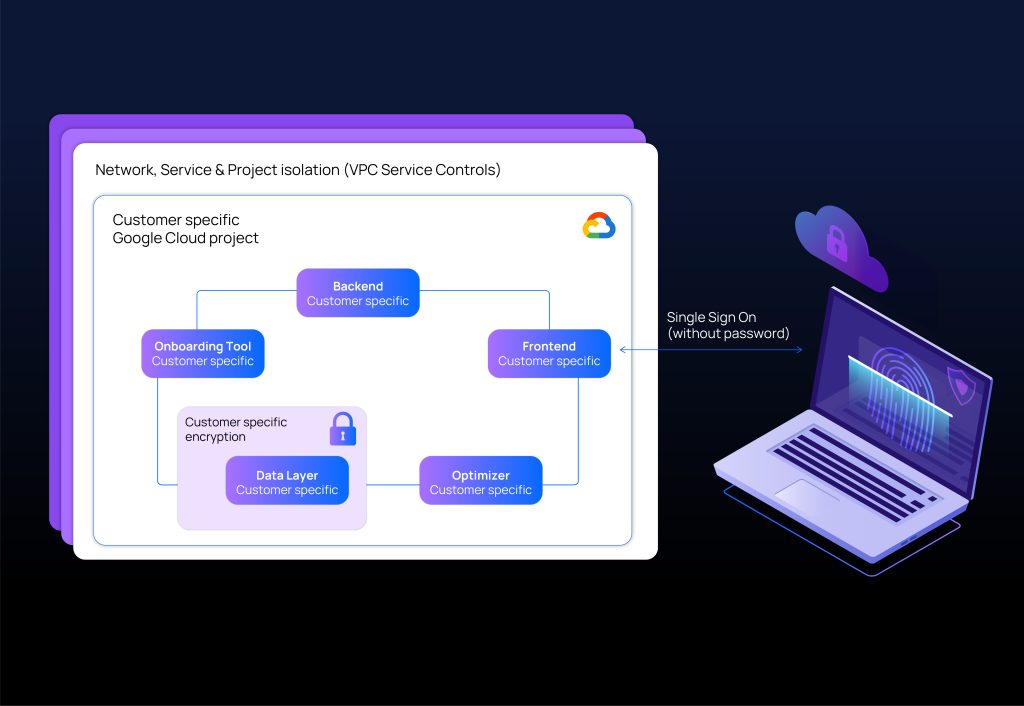
A retail optimization platform handles highly sensitive, business-critical data, such as profit margins, proprietary pricing strategies, and historical transaction volumes. Security cannot be an afterthought.
7Learnings builds its infrastructure, governance, and processes to the highest global enterprise security standards, ensuring peace of mind for retail partners. Our approach to safeguarding your data relies on four core pillars:
Verifiable trust & certifications
We maintain a “trust-but-verify” methodology, ensuring our controls are independently audited and continuously validated.
- SOC 2 Type II certified: Confirms our long-term commitment to operational security, platform availability, and strict internal governance over time.
- ISO 27001 certified: Validates our alignment with international standards for establishing, implementing, and maintaining robust information security management systems.
- Continuous monitoring: We leverage Vanta, a live trust management platform, to monitor our security posture 24/7 and provide real-time visibility into the effectiveness of controls.
- Regular penetration testing: Independent security firms perform comprehensive annual penetration tests on our SaaS and Cloud services to actively identify and mitigate potential vulnerabilities.
Security-first architecture & single-tenant isolation
Unlike typical multi-tenant SaaS providers where data from multiple companies is grouped, 7Learnings employs strict customer isolation to eliminate the risk of cross-contamination.
- Dedicated GCP projects: Every single client is deployed within its own isolated Google Cloud Platform (GCP) project environment.
- Component-specific security: Customer separation is strictly enforced across every layer of our stack, including the Data Layer, Frontend, Backend, Optimizer, and Onboarding tools.
- Network isolation: We utilize VPC Service Controls to completely lock down data within client projects, preventing data exfiltration to unauthorized external networks.
Robust data protection & encryption
Your data remains your property at all times. To guarantee confidentiality, the 7Learnings platform implements elite cryptographic and privacy protocols.
- Encryption everywhere: All data is securely encrypted both in transit and at rest using industry-standard protocols.
- Customer-managed keys: Clients can use customer-managed encryption keys, giving them the ultimate power to instantly revoke access and render data unreadable if necessary.
- Data minimization: We strictly adhere to GDPR principles, collecting and processing only the exact data required to power the machine learning models.
Zero trust model & security governance
7Learnings operates on a Zero Trust architecture, ensuring that internal workflows are just as tightly secured as our outward-facing ones.
- Least privilege principle: Access to systems is granted strictly on a “need-to-know” basis. Only authorized data scientists and cloud administrators can access project data under rigorous oversight.
- Modern authentication: 7Learnings enforces Single Sign-On (SSO) and mandatory Multi-Factor Authentication (MFA) across all operations.
- Infrastructure as code (IaC): Every infrastructure modification is deployed via IaC to ensure absolute configuration consistency, traceability, and auditability.
- Supply chain security: Daily automated vulnerability scans run against all software dependencies and container images to preemptively defend against modern supply chain threats.
A proof of concept is easy to build. A system that holds up under enterprise security requirements, daily retraining, and millions of SKUs is not. 7Learnings runs this stack for retailers today. Book a demo to see how it handles your catalog.