Set prices that are always in fashion
7Learnings combines long-term and short-term demand forecasts to price a style across its whole life, from full price through every markdown wave to clearance. The model accounts for expected returns and the salvage value of stock at the end of the season, then builds the markdown sequence that delivers the most profit across the season rather than the fastest sell-off.
Set optimal prices for each product by region, country, or individual channel. Machine learning models read the price elasticity specific to each channel and factor in the total cost behind it, including landed cost changes from tariffs. Your offer stays competitive in every market you sell in.
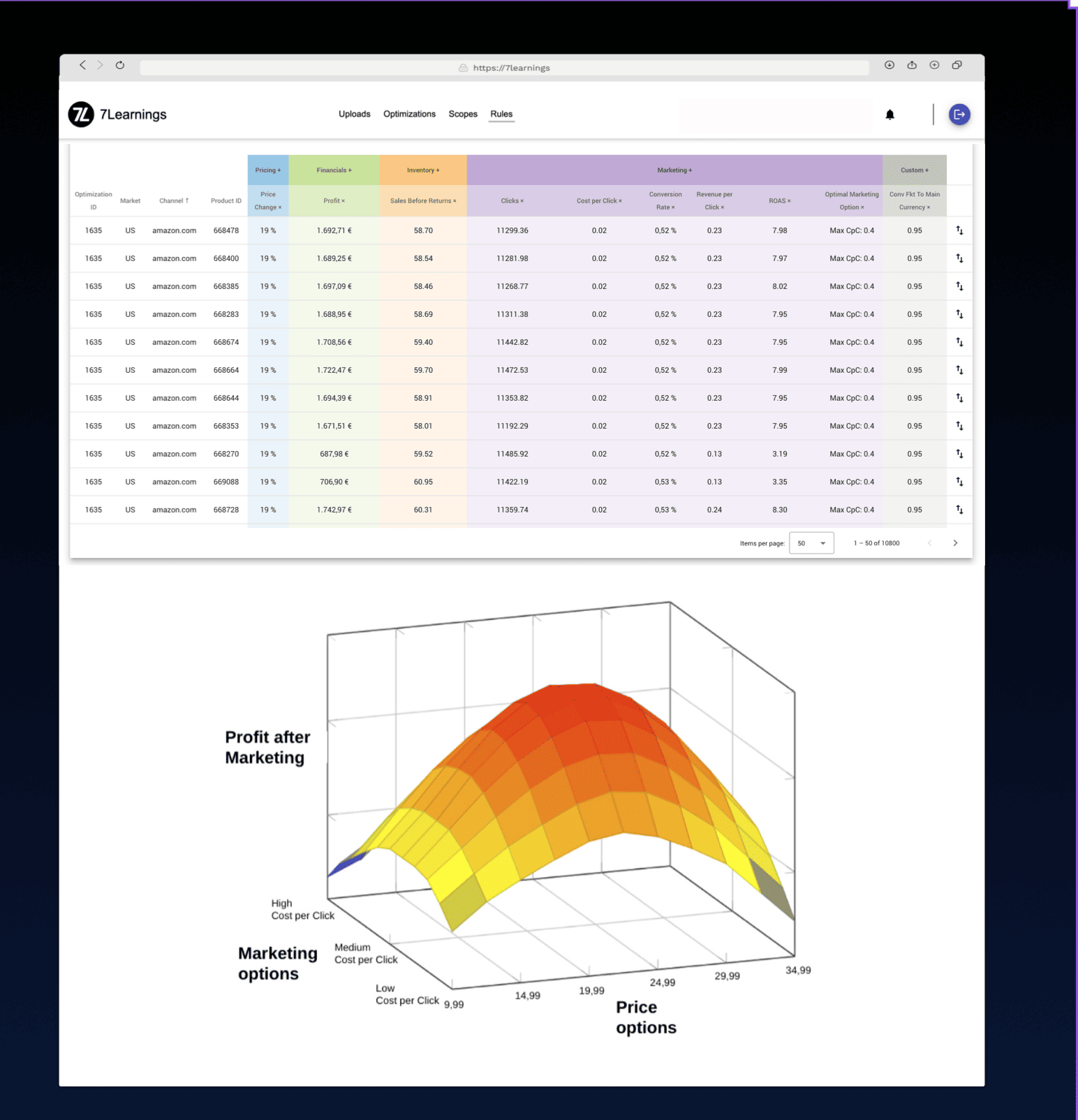
7Learnings empowers you to boost sales, streamline marketing expenditure, and synchronize your marketing and pricing initiatives. Our performance marketing optimization tool precisely forecasts the consequences of different marketing choices on traffic, conversion rates, and cost per click (CPC). We show you the optimal campaign settings and align your marketing and pricing strategies using our joint forecast. Additionally, you can optimize your coupon distribution and discounts, guaranteeing that each decision aligns with your business objectives.
Fashion assortments are variant-heavy: one style lives across a grid of sizes and colors, each selling at its own rate. 7Learnings prices the size curve rather than the style, learning price elasticity across product attributes such as category, color, and fit. That makes it possible to price new arrivals, slow sellers, and low-transaction variants accurately, holding margin on the sizes that sell out and avoiding overstock on the ones that do not.
Most pricing intelligence and dynamic pricing platforms run one core loop: monitor competitors, detect a price change, apply a repricing rule. That loop suits categories where a competitor price exists for nearly every item.
Fashion businesses work differently. Much of the range is private-label or exclusive, so there is no competitor price to read. Demand is seasonal, and the signal that matters is your own inventory: sell-through against plan, stock reach across the size curve, and how many weeks remain before the next collection lands. A fixed markdown calendar answers that signal on a schedule rather than on the data. Most retailers are still working this way; 64% describe their pricing as largely manual and experience-led, and only 4% use fully predictive and automated pricing, according to the Hive Barometer: Pricing.
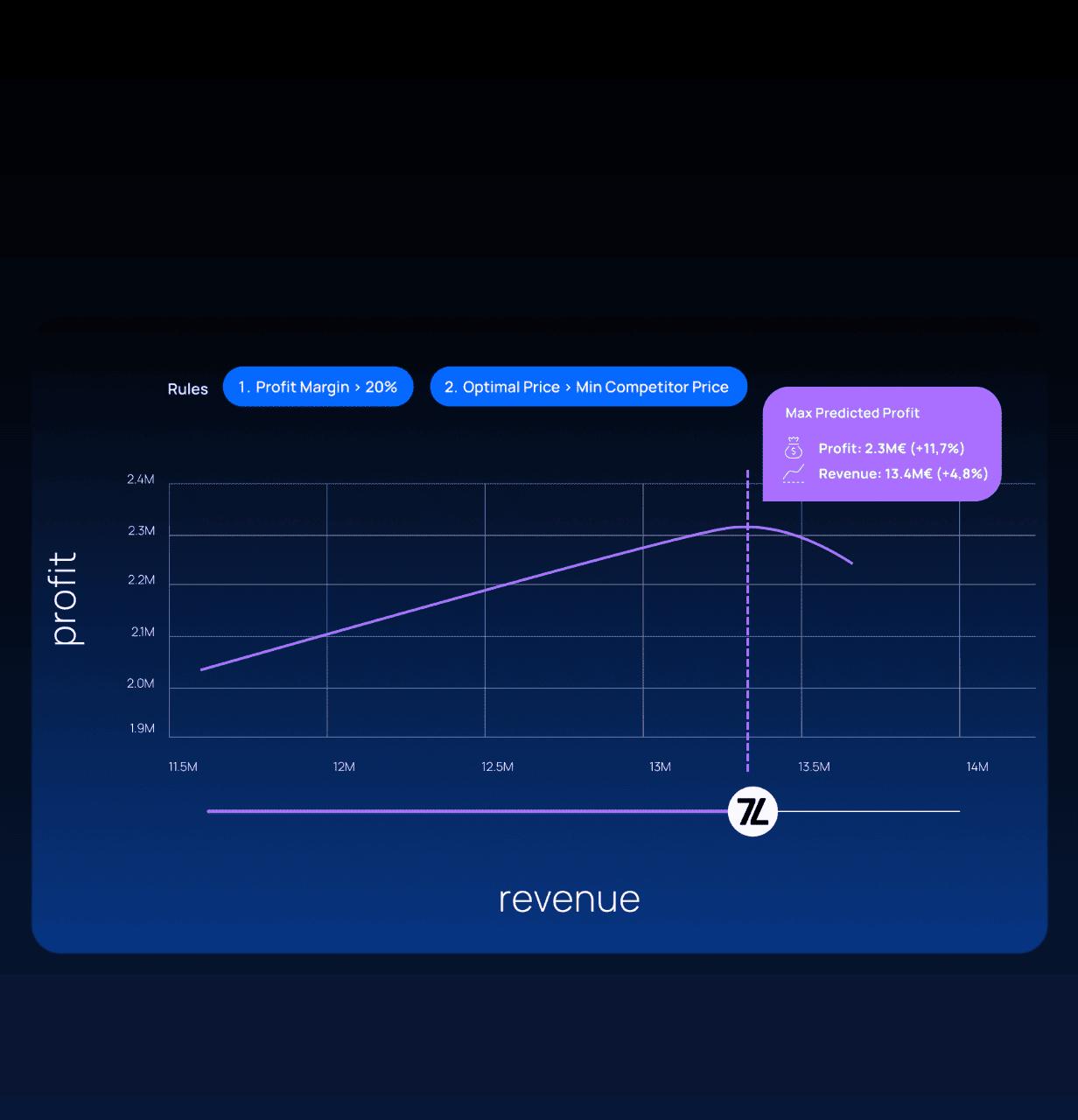
7Learnings forecasts demand and elasticity at the SKU level from your transaction history. That covers private-label goods with no competitor reference, and it turns markdowns into a full-season path rather than discounts in isolation. Landed cost changes, including tariff shifts, feed the same forecast, and you see the projected impact on profit, revenue, and sell-through before a price is published. Competitor prices are one input to that forecast rather than the trigger for it.
experience in fashion category
won in fashion category
avg. result in fashion category
You have questions? We have answers!
7Learnings is an ideal solution for fashion brands and retailers as it is particularly adept at handling assortments of all sizes and products that have many variations. We enable you to find the optimal prices for each sales channel and across the entire lifecycle of your products, taking into account metrics such as expected returns and the salvage value of stock. As a result, our clients achieve a profit and revenue boost of 15% on average.
We work with the data you have. The models learn across the products in your portfolio, so they operate effectively with limited price history. Typically we need around 100 overall price changes and two to three adjustments on high-selling items. Because the models already recognize common elasticity drivers, they can identify them in your assortment even where explicit price changes are thin.
Yes, our optimization algorithm does not depend on competitor data and delivers optimal prices for these product types.
Of course! Our solution can also optimize low-selling products because our algorithm learns across products and attributes.
It prices at the variant level rather than the style level. 7Learnings learns elasticity across product attributes, so each size and color carries its own demand forecast and its own recommended price. That matters because a style rarely sells evenly across its size curve. Pricing the whole style at one discount clears the sizes that would have sold at full price and leaves the broken size run behind.
Discover the power of AI in retail optimization with us. Book a demo now and together, let’s dive into how our solution can transform your business.