

Compare 7Learnings vs Competera on their websites, and the two read almost the same. Both describe AI-led price optimization and demand modeling, and a shortlist built from that tells a Head of Pricing nothing useful.
The real differences sit in five places: decision architecture (whether a price comes from a forecast or from rules), the breadth of data each model consumes, retraining frequency, how far the optimization reaches beyond price itself, and data security.
7Learnings vs Competera: Core philosophy and approach
- Competera applies contextual AI and machine learning models across more than 20 pricing and non-pricing demand drivers. It forecasts the impact of a price change before recommending it, with business rules layered on top and a pricing team in the loop.
- 7Learnings uses demand forecasting as the calculation layer, optimizing toward a commercial target you set and simulating the outcome before any price is published. Rules and guardrails are available on top of the forecast, but the price comes from the model rather than from the rules.
Both platforms are prediction-first, and both are deliberately human-in-the-loop. Competera is built deepest around breadth across categories. 7Learnings is built deepest around assortments priced on their own demand rather than on competitor moves, and around optimizing price, marketing spend, and order quantities against one forecast instead of three.
Competera at a glance
Competera is an enterprise pricing solution built on two products that work standalone or together: Competitive Data and the Pricing Platform. Its contextual AI uses deep learning rather than a single demand elasticity curve, accounts for cross-elasticity and product roles, and retrains each pricing cycle, daily or weekly. The company reports 50+ enterprise retail customers and claims 95%+ accuracy in predicting revenue and margin impact.
Its solution set spans competitive price intelligence, dynamic and omnichannel pricing, promotion management, and markdown optimization, with industry pages covering grocery, health and beauty, consumer electronics, apparel and footwear, sporting goods, and more. It was named a representative vendor in Gartner’s 2024 Market Guide for retail unified price, promotion, and markdown optimization.
Best fit: large, multi-category retailers that want broad elasticity modeling across categories, particularly where competitive positioning is central to the pricing strategy. Reviewers note a steeper learning curve during setup and integration timelines that can run long.
7Learnings at a glance
7Learnings is a prediction-first platform where the price comes from the demand forecast rather than from a rules engine. Predictive AI forecasts demand, return rates, and price elasticity at SKU level, and the optimizer turns those forecasts into prices matched to a commercial goal. Rules and guardrails sit on top of the forecast as limits on the result, not as the thing producing it.
What sets 7Learnings apart is target steering. Teams pick the goal, such as a minimum profit margin, a sell-through deadline, or a revenue floor, and the optimizer finds the prices that reach it. Every recommendation is simulated before it publishes, and nothing goes live without passing through the approval workflow.
The second distinction is scope. 7Learnings sells three products off the same demand model: price optimization, performance marketing optimization, and order optimization. The forecast that sets a price also allocates products across ad groups with specific ROAS or CPC targets, and informs how much of each product to reorder.
Best fit: B2C and omnichannel retailers with variant-heavy or stock-constrained assortments priced on their own demand rather than competitor moves, including broken size runs, stacked promotions, marketplace pricing, and private label with no reference price. Deepest in fashion, home & living, pharmacy, and spare parts.
7Learnings vs Competera: Key feature comparison
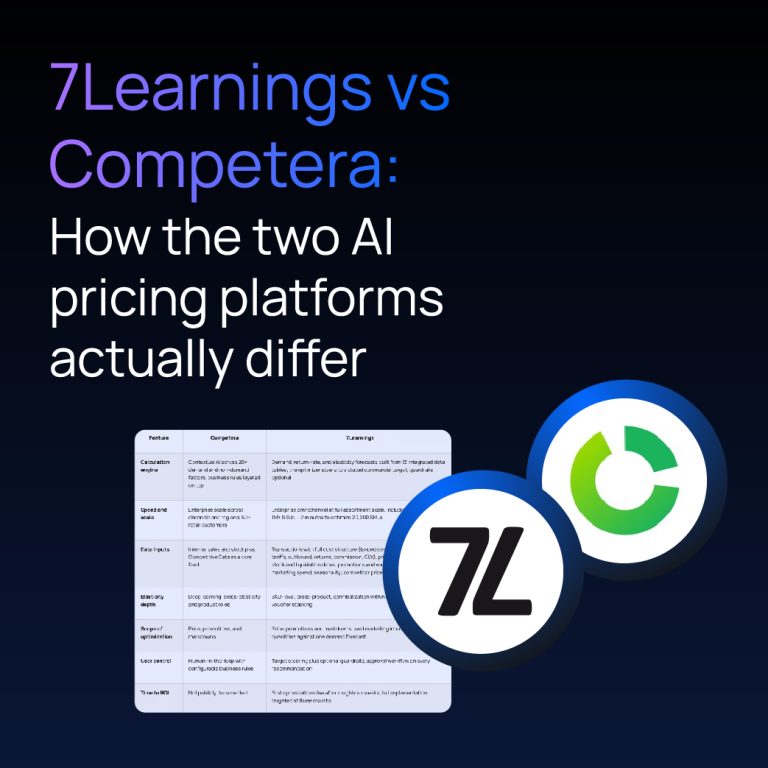
Feature | Competera | 7Learnings |
|---|---|---|
Calculation engine | Contextual AI across 20+ demand and non-demand factors, business rules layered on top | Demand, return-rate, and elasticity forecasts built from 13 integrated data tables; the optimizer steers to a stated commercial target, guardrails optional |
Speed and scale | Enterprise scale across channels and regions; 50+ retail customers | Enterprise omnichannel at full assortment scale, including clients running 1M+ SKUs; ~2 minutes to optimize 20,000 SKUs |
Data inputs | Internal sales and stock plus Competitive Data as a core feed | Transactions with full cost structure (landed cost including duties and tariffs, outbound, returns, commission, CLV), prices, product attributes, stock and liquidation dates, promotions and vouchers, traffic and marketing spend, seasonality; competitor prices optional |
Elasticity depth | Deep learning, cross-elasticity and product roles | SKU-level, cross-product, cannibalization within a category, promotion and voucher stacking |
Scope of optimization | Price, promotions, and markdowns | Price, promotions and markdowns, paid marketing intensity, and order quantities against one demand forecast |
User control | Human-in-the-loop with configurable business rules | Target steering plus optional guardrails; approval workflow on every recommendation |
Time to ROI | Not publicly documented | First optimizations live after roughly six weeks; full implementation targeted at three months |
For row-by-row detail, see the full capability comparison below.
The criteria that separate AI pricing platforms
Each of these shifts the final price in a different way, and only one of them usually makes it into a vendor demo.
- Decision architecture: whether a price comes from reacting to competitive signals or from forecasting demand and optimizing toward a target. It determines whether the price reflects what competitors did or what your customers are likely to buy.
- Data breadth: what the model is allowed to see. A model fed price and competitor data alone cannot reason about margin, returns, or marketing cost, which means it optimizes a number that is not your profit.
- Retraining frequency: how often the demand model relearns from new data. A model retrained daily prices the article on the floor, while one trained weeks ago prices the article the buyer planned.
- Scope of optimization: whether the platform sets a price in isolation or optimizes price alongside the paid marketing spend and inventory decisions attached to the same product.
- Data security: where your transaction data is stored and how it is isolated from other customers. It often decides whether a platform clears procurement at all.
Decision architecture: How each platform arrives at a price
Competera forecasts the impact of a price change before recommending it, with business rules layered on top and a pricing team in the loop. 7Learnings puts the demand forecast at the center and steers to a commercial target, with rules such as competitor-matching available as limits on the result rather than as the thing producing it.
The distinction is invisible on most of an assortment. It becomes expensive where a rule has nothing reliable to react to.
The reactive path: Match the competitor, give up the margin
Take a private-label winter coat selling for $120 at a $60 unit cost, so each sale earns $60 of margin. There is no identical competitor product, but a repricer set to match the lowest competitor finds a comparable coat listed elsewhere at $99 and matches down, cutting margin per coat to $39.
Match the competitor at $99 | Hold at $120 | |
Margin per unit | $39 | $60 |
Units sold | 105 | 100 |
Total margin | $4,095 | $6,000 |
Source: When to replace pricing software that’s costing you margin, 7Learnings.
Because the coat has no exact substitute and its buyers were not cross-shopping that competitor, the cut barely moves volume. Five more units sell, and roughly $1,900 of margin goes with them. The repricer did exactly what it was told. It had no way to know the product was inelastic.
The forecast path: Price on estimated demand
An optimizing platform starts from demand. It estimates how sensitive the coat is to price, recognizes it as inelastic, and holds at $120, with the competitor’s price entering the decision as one input among several rather than as the basis for it.
The same logic runs the other way on products that genuinely are elastic, where the forecast supports a cut the rule would never have reached. What changes is not the direction of the price but what the price is answering to.
Across an assortment of private-label lines, size and color variants, and long-tail products with no clean competitor reference, that decision repeats thousands of times a season. At that scale, the difference stops being a per-SKU rounding error and becomes the structure of the margin report.
What the model is allowed to see
A demand model is bounded by its inputs. If the only things it consumes are prices and competitor prices, it can optimize a price position but not a margin, because it has no view of what the product actually costs you to sell.
7Learnings integrates 13 data tables, six of them required and the rest optional and addable later. Beyond transactions, prices, product attributes, and stock, that includes purchase prices as net landed cost with freight, customs duties, tariffs, insurance, and handling folded in; outbound, inbound, and return-handling costs; marketplace commission rates that step with the price band; voucher and promotion activity; paid and organic traffic with the marketing intensity behind it; customer lifetime value; and season and liquidation dates per product.
That matters most on the cost side. The performance marketing product optimizes profit after marketing cost by accounting for predicted returns, logistics costs, tariffs, stock-outs, commission costs, and conversion rates at product level. A platform that optimizes gross margin on a product carrying a 30% return rate and a marketplace commission is optimizing a number the P&L never sees.
Beyond price: Marketing and ordering off the same forecast
Both vendors treat promotions and markdowns as pricing decisions rather than separate workflows. Competera manages promo and markdown campaigns alongside regular repricing in one platform, with simulation before launch and margin guardrails. 7Learnings models vouchers, campaign windows, and stacked discounts inside the demand forecast and can rank which groups are most worth promoting.
Where they diverge is the ad bid on one side of the price and the reorder quantity on the other.
Paid marketing. 7Learnings predicts the profit and revenue impact of campaign changes at product level and allocates products across ad groups with specific ROAS or CPC targets, pushing optimized tROAS or CPC settings back to the channel by API. When a price cut lifts conversion, the system lowers the bid to protect profit after marketing. The published results include a European fashion brand on Amazon at 27% profit and 34% revenue uplift from product-specific CPC steering, and a fashion retailer on Google Shopping at 52% profit and 53% revenue from differentiated ROAS targets. Across clients, 7Learnings reports typically more than 10% profit increase after marketing costs. Competera publishes no equivalent paid-media product.
Ordering. The same demand forecast drives reorder quantities, factoring in price elasticity, planned promotions, lead times, minimum order quantities, and future purchase costs, so a planned markdown raises the reorder suggestion rather than being discovered after the buy. Competera publishes no ordering or replenishment product.
This is the cross-silo argument in practice. Retailers lose margin less to market volatility than to pricing, marketing, and inventory decisions that were never designed to work together.
Retraining frequency and what it costs you in season
Elasticity for a seasonal article does not hold still. A coat behaves differently in week two of the season than in week ten, and a model trained on last month’s curve prices the article the buyer planned rather than the one on the floor.
7Learnings retrains daily on live transaction, stock, and attribute data, and reruns the optimization across the assortment on the same cadence. Competera retrains each pricing cycle, daily or weekly. Rule-based repricers do not retrain at all; they refresh competitor data while the logic stays fixed.
Most vendors do not publish their cadence, so put three questions to every platform on your shortlist: how often the demand model retrains, on what data, and what the system does in the window between retrains.
Elasticity modeling depth for large seasonal assortments
Three things separate pricing technology built for a fashion assortment from software built for a catalog: cannibalization within a category, promotion and voucher stacking, and new articles with no sales history. 7Learnings models all three, with cannibalization handled within the category, and forecasts demand for brand-new or long-tail SKUs from catalog-wide conversion patterns rather than from the product’s own history.
DK Company, a multi-brand fashion group selling across more than 35 countries, improved profit by 19%, revenue by 29%, and sales by 28% at once (read the DK Company case study). Tamaris cut its discount rate by 5% while halving the time spent on price adjustments (read the Tamaris case study). Both are European results, and read as validated benchmarks rather than claims about any specific market.
Cross-assortment learning: pricing a new collection on day one
A new collection has no price history, so a per-SKU model has nothing to learn from. Models that learn price elasticity across product attributes instead price a new article from the demand pattern of comparable items in the same category, fabric, and brand tier.
Private-label and long-tail products with no competitor reference price
Private label has no competitor price to anchor to, removing the input competitive pricing depends on. Demand-based optimization prices these from your own customers’ response, which is why heavy private-label exposure favors an engine needing no competitor data.
Security, data isolation and compliance
Both vendors run on Google Cloud and both are ISO/IEC 27001:2022 certified, so certification alone will not separate them.
What differs is the depth of the published detail. Competera describes a multi-layer architecture with TLS 1.2+ in transit, AES-256 at rest, isolated Kubernetes namespaces per workload, SSO and MFA, regular penetration testing, and 99.5% platform availability. 7Learnings isolates every client in a dedicated Google Cloud project rather than a shared environment, holds SOC 2 Type II in addition to ISO 27001, and offers customer-managed encryption keys (security and compliance details).
If your procurement team requires a SOC 2 Type II report, dedicated project-level isolation, or custody of your own keys, that is where the two diverge. Ask both the same four questions: tenancy model, key custody, which certifications are current and when they were last audited, and where transaction data is processed.
Full capability comparison
Criterion | Capability | Competera | 7Learnings |
Decision architecture | Demand forecast before price is set | Supported | Supported |
Price produced from the forecast rather than a rule | Not publicly documented | Supported | |
Target steering to a commercial goal | Supported (revenue and margin goals) | Supported (profit, revenue, margin, sell-through) | |
Pre-live simulation of recommendations | Supported | Supported | |
Approval workflow before publication | Supported | Supported | |
Data breadth | Transactions, prices, attributes, stock | Supported | Supported |
Competitive price data as a native product | Supported | Optional input | |
Full cost structure (landed cost, duties and tariffs, outbound, returns, commission) | Not publicly documented | Supported | |
Marketing spend and intensity as a model input | Not publicly documented | Supported | |
Retraining | Daily model retraining | Supported (daily or weekly cycle) | Supported |
Elasticity | SKU-level elasticity | Supported | Supported |
Cross-elasticity and cannibalization | Supported | Supported (within category) | |
New articles with no sales history | Not publicly documented | Supported | |
Return-rate forecasting per price point | Not publicly documented | Supported | |
Pricing without competitor data | Limited | Supported | |
Scope of optimization | Promotion planning and simulation | Supported | Supported |
Markdown and clearance optimization | Supported | Supported | |
End-of-season liquidation profit optimization | Not publicly documented | Supported | |
Paid marketing intensity co-optimized with price | Not available | Supported | |
Ordering and replenishment optimization | Not available | Supported | |
Bundle pricing | Not publicly documented | Supported | |
Scale | 1M+ SKU assortments | Not publicly documented | Supported |
Omnichannel: own shop, marketplaces, stores | Supported | Supported | |
Security | ISO/IEC 27001:2022 | Supported | Supported |
SOC 2 Type II | Not publicly documented | Supported | |
Dedicated per-client cloud project | Namespace-level isolation | Supported | |
Customer-managed encryption keys | Not publicly documented | Supported | |
Integration | API and developer documentation | Supported | Supported |
Legend: Supported, Limited, Not available, Not publicly documented. Not publicly documented reflects the absence of a public source, not absence of the capability.
Which platform fits which retailer
Competera fits retailers pricing across many categories, channels, and markets where competitive positioning is the central problem, particularly in grocery and SAP-integrated environments. Competitor data feeds the model as a core input, and the platform covers promotions and markdowns alongside base pricing.
7Learnings fits where prices should follow forecast demand rather than competitor moves: variant-heavy and long-tail assortments, stock-constrained categories, and private label with no reference price. It goes deepest in fashion and also serves pharmacy, eyewear, and sporting goods. It is not built for grocery or for pricing embedded inside an SAP deployment. It is the stronger fit where pricing, paid marketing, and ordering sit close enough together that optimizing them separately is visibly costing margin.
The practical difference day to day is who sets the target. You choose the commercial goal, whether profit, revenue, sell-through, or margin, and can change it by category or partway through the season. Most retailers choose profit.
Implementation needs two or more years of transaction history and a standard three-month proof of concept run against a control group, with first optimizations typically live after about six weeks. Every recommendation passes through an approval workflow before it publishes. Retailers using 7Learnings increase profit by 15% on average.
Frequently asked questions about 7Learnings vs Competera
What is the main difference between 7Learnings and Competera?
Both forecast demand before recommending a price, and both keep a pricing team in the loop. Competera pairs contextual AI across 20+ demand factors with Competitive Data as a core feed, built for breadth across channels and regions.
7Learnings puts the demand forecast at the center, steers to a commercial target you set, and extends the same forecast to paid marketing bids and order quantities. It goes deepest on seasonal, variant-heavy, and private-label assortments where competitor reference prices are thin.
Which pricing platform is better for fashion retailers?
Both serve apparel. Fashion needs size and color variants, private-label goods with no competitor reference price, stacked promotions, and optimization toward the goal you set rather than fast clearance, and 7Learnings is purpose-built for that complexity. Competera brings broader competitive intelligence across markets and channels.
The deciding question is whether your margin depends more on seasonal and variant complexity or on competitive positioning across markets.
Does 7Learnings need competitor price data to optimize prices?
No. The forecast runs on your own transaction history, cost structure, product attributes, and stock levels, which is why it works on private label and long-tail products with no competitor reference price.
Competitor data can be added as an input, and competitor-matching can be set as a guardrail, but neither is required for the engine to produce a recommendation.
Can 7Learnings optimize marketing spend and inventory as well as price?
Yes. The same demand forecast steers paid marketing at product level, in cost-per-click or target ROAS terms, and pushes those settings back to the channel by API. It also drives reorder quantities against lead times, minimum order quantities, and future purchase costs. Competera publishes promotion and markdown optimization but no paid-media or ordering product.
How often do AI pricing models need to be retrained?
Daily is the standard for fast-moving retail, because new products and shifting demand make a model stale quickly. 7Learnings retrains daily. Competera retrains each pricing cycle, daily or weekly.
Rule-based pricing tools do not retrain at all; they refresh competitor data while the logic stays fixed. Ask how often the demand model updates, which matters more than how often prices change.
How long does it take to implement 7Learnings?
7Learnings targets full implementation in three months, with the first optimizations going live after roughly six weeks. You supply two or more years of transaction history, product attributes, and stock data, and the 7Learnings team handles preparation, connecting through BigQuery, Snowflake, Microsoft Fabric, Shopify, Tradebyte, or the major cloud storage providers.
The proof of concept runs as a controlled test against your existing process, so the uplift is attributable rather than assumed.
Is 7Learnings SOC 2 Type II and ISO 27001 certified?
Yes. 7Learnings holds SOC 2 Type II and ISO/IEC 27001:2022 certifications. Each client is isolated in a dedicated Google Cloud project, and data is encrypted in transit and at rest, with optional customer-managed encryption keys. Competera is ISO/IEC 27001:2022 certified and does not publish a SOC 2 Type II report.
More AI pricing platform comparisons
Not every tool in the category is price optimization software. Omnia Retail is rule-based repricing, Prisync is competitor price monitoring, and Pricefx is B2B price management and quoting.
If you’re still building your shortlist, read how to select an AI pricing tool. To see why prediction-first and rule-based pricing produce different results, read rules-based vs machine learning-based pricing.
Competitor prices are useful context, but a forecast of your own demand is what shows the profit impact of each price before it goes live. Book a 7Learnings demo and the team will run that forecast against your transaction and stock data, or see how seasonal complexity is handled on the fashion pricing page.