


Most teams don’t ask whether to replace pricing software until something forces the question. The tool runs, prices update, and the line item gets renewed. However, “it works” and “it’s making us money” are different, and the gap between them is where results are impacted.
Consider a retailer that ran a basic repricing tool for about a year. It adjusted prices on competitor data and preset rules, and did that reliably. What it couldn’t do was account for price elasticity. As a result, it kept matching competitors on low-elasticity products, where matching won nothing.
The retailer steadily gave up profit on items customers would have bought at the higher price. The tool didn’t fail; it simply capped out, and the cost of that ceiling only showed up in the margin report.
When considering whether to replace pricing software you should consider whether the current tool forecasts demand and prices toward a commercial goal, or does it only automate competitor- and rule-based changes? A tool doesn’t have to be broken to be worth replacing. This is precisely what this guide will help you understand.
We’ll dive into what separates a tool that optimizes from one that only automates, what the ceiling costs, how to tell you’ve hit it, and how to build the case to move.
Having a tool and optimizing prices are different things
Plenty of pricing software sets prices automatically. In fact, a rule-based repricer and a predictive platform can both change prices without anyone touching a spreadsheet. Both fall under the broad label of dynamic pricing, and vendors often market either one as dynamic pricing software. The difference is what the automation is pointed at.
A repricer executes instructions: match the lowest competitor, drop 20% after six weeks, hold a fixed margin. It automates the how of a decision you already made. A predictive tool forecasts how demand will respond, sets prices to achieve a defined goal (e.g., season profit, revenue, sell-through, or markdown optimization), and then adjusts as conditions change.
The tool worth having does both: it sets prices automatically and optimizes the outcomes those prices produce. Automation alone gets you speed, but price optimization is what turns that speed into tangible results.
That combination is sometimes called a hybrid pricing model: automation and optimization working together. Use precise terms and stay peer-to-peer; the point is capability depth, not competence.
What rule-based tools and repricers actually do
A rule-based tool applies the pricing logic you give it and reports what happened. Prisync is a familiar example of this category. That’s useful when the rule matches reality, but it has no way to know when it doesn’t.
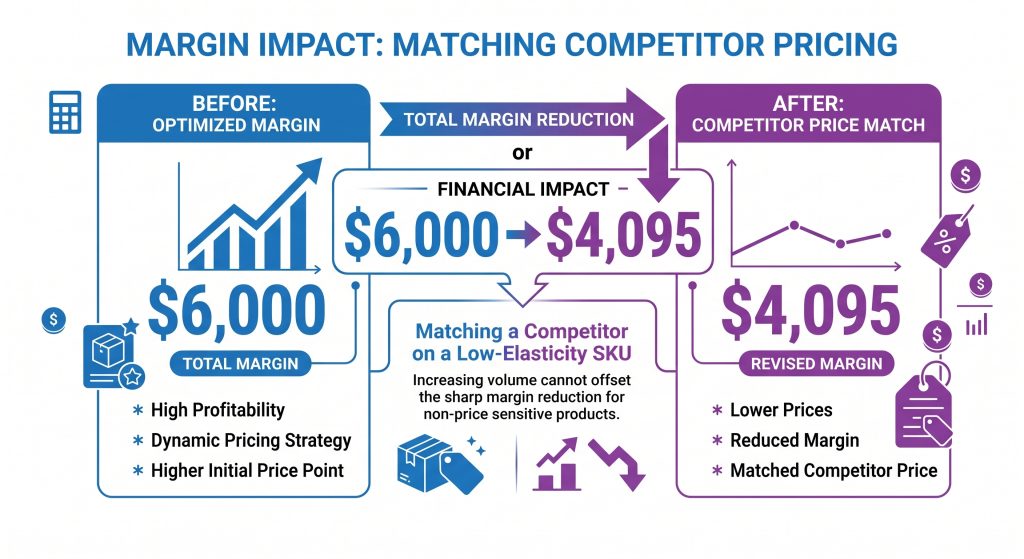
Say a repricer is set to match the lowest competitor price across the catalog. That logic is sensible for branded goods with true substitutes, but the same rule runs on everything, including a private-label winter coat with no identical competitor product. The coat sells for $120 at a $60 unit cost, so each sale earns $60 of margin. The tool finds a comparable coat listed elsewhere at $99 and matches down, cutting margin per coat to $39.
Because the coat has no exact substitute and its buyers weren’t cross-shopping that competitor, the cut barely moves volume: units edge from 100 to 105. Matching “won” the comparison and lost money doing it. Margin falls from $6,000 (100 × $60) to $4,095 (105 × $39): or $1,900 given away to sell five more coats.
The repricer did exactly what it was told, but it had no way to know the product was inelastic. Reacting to a competitor’s price is not the same as understanding demand. Multiply that across an assortment, and that becomes a structural issue.
What predictive optimization adds on top
Optimization starts from demand, estimating how sensitive each product is to price, including private-label and variant-heavy lines, with competitor reference used as an additional data point rather than the basis for the whole decision. Then it forecasts the profit, revenue, and sell-through impact of a price before it goes live.
Instead of asking what the competitor is doing, it asks what price gets closest to the goal you set. It can tell you what’s actually driving each recommendation instead of leaving it in a black box.
On the coat above, an optimizing tool would recognize the product as inelastic and hold the price, protecting the $60 margin, a basic case of margin protection, instead of chasing a match that changes nothing.
The cost of using rule-based tools and repricers
Without deeper pricing analytics, it is difficult to establish the negative impact of rule-based pricing until the review of the margin report that comes after the fact.
In the Hive Barometer 2026, a survey of senior retail leaders, 38% of retailers named missed revenue opportunities as the single biggest cost of inefficient pricing, and 29% pointed to margin erosion. Those are the two failure modes a capped-out tool produces:
- Prices left too low on products that would have sold anyway
- Prices left unoptimized on products that could have carried more
Against that, 7Learnings sees an average profit uplift of 15%+ in controlled AB tests across its fashion clients. The distance between those numbers is what the status quo costs.
McKinsey’s State of Fashion 2026 puts margin, cost, and cash strategy near the top of the 2026 agenda, with pricing and inventory management among the most pressured parts of the economic model. A tool that can’t optimize essentially leaves that pressure unanswered.
How to tell your current tool has hit its ceiling
Pricing teams can be quick to recognize the signs that their pricing management software has outlived its purpose. A few clues to look out for include:
- The team maintains rules instead of steering outcomes. Most of the week goes to adjusting, testing, and patching pricing rules rather than deciding what the business should achieve and checking whether it did.
- The tool reacts instead of forecasting. It responds to competitor moves and other market signals but can’t tell you the projected impact of a price before you set it.
- It breaks on fashion complexity. Size-and-color variants and private-label goods with no competitor price to match fall back to manual input, because the tool has nothing to react to.
- It can’t hold consistent prices across channels. The same SKU now sells through your own store plus Amazon, Google Shopping, Zalando, and other marketplaces, each with different competition, fees, and buy-box dynamics. A rule set that works on one channel produces margin-blind prices on the next.
Rule maintenance is eating the team’s time
A rule-based system pushes the thinking back onto the team. Every product, channel, and season adds rules to write and maintain, and that maintenance grows with the assortment rather than shrinking as the tool learns.
A capped-out tool is often recognizable by how much skilled time it consumes just to keep running. That’s time that isn’t going into strategy.
The long-tail problem your rules cannot solve
Rules work while a human can hold the logic in their head. Past a certain SKU count, they can’t. A retailer with tens of thousands of products can’t hand-tune a rule for each one, so the long tail gets a blunt, one-size policy that ignores how differently those items behave.
This is where rule-based approaches break and demand forecasting wins. A model can estimate elasticity across 20,000+ SKUs and price each one on predicted demand, including the slow-movers no one has time to analyze by hand.
What pricing software replacement actually costs
The objection that usually stalls a replacement is implementation. Teams picture the year-long rollouts associated with enterprise suites and decide the disruption isn’t worth it.
A specialized pricing layer works differently. It connects to the data you already have, forecasts demand, and delivers optimized prices back into the systems your team already uses to set and publish them. Your commerce platform and price-execution setup stay in place, so the tech lift is low and first measurable ROI can land within a month, well short of the year a full enterprise rollout takes.
GALERIA, a German department store running more than two million SKUs, reached ROI within two months with 7Learnings, alongside a 230% revenue increase and a 50% margin uplift. As a European result, it’s a validated benchmark rather than a US-specific promise, but it shows a fast payback is realistic even at enterprise scale.
If the fear is a long, risky migration, the honest answer is that a focused pricing tool is one of the lighter lifts in the stack, a point worth weighing in any build-versus-buy decision.
Building the case to replace
The strongest way to justify a switch is to prove it before ripping anything out. Two steps make the case evidence-led rather than faith-based.
Run an AB test of the new approach against the incumbent: price part of the assortment with the new tool and a comparable part with the existing process, then compare profit, revenue, and sell-through over the same period.
A verifiable test result is far more persuasive to finance than a projected figure. INTERSPORT Krumholz did exactly this and recorded a 118% profit increase and a 52% revenue increase in an AB test, with no sacrifice in sales volume. This is the model for making a switch on evidence rather than a pitch.
Next, use scenario modeling to build finance buy-in before the rollout. Showing the projected margin impact of the new approach on your own numbers turns the conversation from “another tool to approve” into “here is the margin we’re leaving on the table.”
For a structured way to compare options against your requirements, our guide to choosing the best pricing software and companion piece on selecting an AI pricing tool both lay out the criteria that matter.
The profit your current tool leaves on the table
The cost of keeping a tool that has capped out isn’t a line you’ll see on an invoice. It’s the margin it leaves on the table every season a low-elasticity product gets matched down, a long-tail SKU gets a blunt rule, or a channel gets a price that ignores its economics. That cost compounds as the assortment grows and the channel mix widens.
Replacing pricing software comes down to whether the tool can do the job the business now needs: forecasting demand and optimizing prices toward a goal, rather than only automating yesterday’s rules. That is the honest measure of when to replace it.
A tool that has hit its ceiling costs you margin every season. Use the 7Learnings profit uplift calculator to put a figure on that against your own volumes and see if the status quo is a saving or a bill.
Frequently asked questions about replacing pricing software
When should you replace your pricing software?
Replace it when the tool can no longer optimize toward a commercial goal: when it only automates rule- and competitor-based changes and can’t forecast how demand will respond to a price.
Practical triggers include a team spending more time on price management busywork than steering outcomes, prices that can’t hold across a growing set of channels, and an assortment large enough that rule maintenance has become unmanageable. The trigger is capability, not age: a tool that still can’t optimize after years is the one to replace.
Is switching pricing software too disruptive to be worth it?
Usually not, because a specialized pricing layer is a lighter lift than the enterprise rollouts most teams picture. It sits on top of existing systems rather than replacing them, so the tech lift is low and first measurable ROI can arrive within a month.
GALERIA reached ROI within two months across more than two million SKUs. The lower-risk path is to AB test the new tool against your current process first, so the switch is proven on your own data before any full migration.
How is predictive pricing software different from a rule-based tool?
A rule-based tool applies instructions you set (e.g., match a competitor, discount after a set period) and reports what happened afterward. Predictive pricing intelligence software forecasts how demand will respond to a price before it goes live and sets prices to reach a goal such as profit or sell-through, including for products with no competitor price to match.
Both can automate price changes; the difference is that predictive software optimizes the outcome rather than only executing the rule.
How do I justify replacing a pricing tool to finance?
Lead with evidence. Run an AB test comparing the new approach against the incumbent on profit, revenue, and sell-through, and bring a verifiable result rather than a modeled estimate.
INTERSPORT Krumholz’s AB test showed a 118% profit increase with no loss of sales volume. Pair that with scenario modeling on your own numbers to show the margin currently being left on the table. Framing the decision as recovering lost margin, rather than adding a cost, is what moves a CFO.