

State of Pricing Software 2026: While the early 2020s were defined by automating manual tasks, the current market is defined by predictive AI. Fashion retailers are moving away from rigid, rule-based systems that merely react to competitors, favoring “goal-driven” platforms that can predict demand and optimize for net profit/revenue/sales precision. This guide evaluates the top pricing software available for fashion retailers in 2026, distinguishing between legacy rule-based tools and the next generation of predictive platforms like 7Learnings.
There are now dozens of pricing solutions on the market, which can make selecting the right one for your business a laborious task. This is especially pronounced as many vendors claim to offer AI, automation, and optimization despite their differing capabilities. Here we break down exactly what to look for and how today’s top pricing tools compare.
This guide walks you through:
- The key criteria to evaluate pricing software for fashion retailers
- A detailed comparison between 7Learnings and other tools
- An overview of additional pricing software solutions to consider
To generate this guide, we have analyzed publicly available information, including data gathered from publicly available reviews, rankings, and testimonials.
Whether you’re upgrading from a rule-based system or investing in pricing technology for the first time, this resource will help you identify the best pricing software for your fashion retail business and make a confident decision.
What fashion retailers actually need from AI pricing software
Fashion pricing is a different problem from pricing most other retail categories, which is why a general-purpose tool can test well and still underperform on your assortment.
For example, a jacket is a style that lives in a grid of sizes and colors, each variant selling at its own rate. Much of the range is private label or exclusive, so there is no competitor price to match against. Demand is seasonal – a sweater that should hold its black price in September has to clear before the spring range lands. That price depends on stock reach, sell-through, and remaining margin.
McKinsey’s State of Fashion puts inventory discipline and margin protection at the top of the 2026 agenda, with tariff pressure now adding to landed costs. Pricing is one of the few levers that works on both sides of that problem at once.
Why generic pricing tools underserve fashion complexity
Most pricing tools were built for categories where a competitor price exists for almost everything, and demand is relatively stable.
For fashion assortments, two issues commonly arise. The tool relies on competitor feeds, which it lacks for private-label and exclusive lines, and it treats each markdown as a one-off decision rather than as a step in a season that ends in clearance. The result is prices that look reasonable in isolation but leave margin on the table across the full season.
Handling size and color variants, private-label goods, and end-of-season markdowns well is what separates a fashion-ready pricing engine from a general one. It is also where the market still has room to move: 64% of retailers describe their pricing as “largely manual and experience-led,” and only 4% run fully predictive, automated pricing.
Prediction-first vs. rules-first: The question that matters most
Before diving into any feature comparison, you should settle one architectural question. Does the platform predict what will happen before a price changes, or does it react after the fact?
A rules-first tool applies the logic you give it (match the cheapest competitor, drop 20% after six weeks) and then reports how that went. A prediction-first tool forecasts the outcome of a price or markdown on profit, revenue, and sell-through before it goes live, and sets prices to the goal you choose.
Think of the difference between driving a route yourself and getting a score afterwards, versus a system that models the road ahead and steers accordingly.
The criteria fashion retailers should evaluate in AI pricing software
Nine factors predict whether a platform will perform on a fashion assortment. Together, they define what good pricing analytics and price optimization looks like in this category. Use them to structure your evaluation.
- Decision architecture. Whether the platform forecasts outcomes before prices change or applies fixed rules and reports afterward. This is the single biggest determinant of whether pricing stays proactive as your assortment and season shift.
- Model inputs and continuous learning. What data the models use, and whether they keep learning from your sales. A fashion-ready tool gets sharper as it ingests more of your own history, rather than needing manual recalibration each season.
- Price elasticity modelling. Whether the platform models how demand responds to price at the SKU level, including for private-label items with no competitor reference. Elasticity is now a boardroom conversation, letting you price confidently where there is no market price to copy.
- Consideration of all costs. Whether returns, shipping, and overhead are in the profit calculation, or only gross margin. In fashion, return rates alone can turn an apparently optimized price into a loss.
- Goal-driven optimization. Whether you can set a commercial objective, such as season profit, revenue, or sell-through, and have the system find the prices, or whether you have to hand-build the rules to get there. This is the difference between steering by outcome and micromanaging inputs.
- Granular forecasting. Whether the platform forecasts cost, revenue, and sales at the product and day level, making reliable what-if simulation and markdown timing possible.
- Data onboarding and integration. How flexibly the platform connects to your systems, and how fast it goes live. A rigid single integration can add months before you see any value.
- Support model. Who you actually work with: a dedicated specialist who understands pricing, or a general support queue. Fashion pricing questions are technical, and the answer quality depends on who picks up.
- Security. How your pricing and transaction data is protected and isolated, and which independent certifications back that up, for example SOC 2 Type II and ISO/IEC 27001. Enterprise buying committees increasingly gate on this, so confirm it early.
How 7Learnings compares to other retail pricing platforms
Fashion teams shortlist these platforms most often. Read the table as a map of how each approaches the criteria above; the write-ups that follow add the detail, including where a tool’s fashion track record is proven and where it is not.
You will also come across names like Competera, Pricefx, and Prisync in this category, covering competitor monitoring, B2B price management, and price tracking respectively. They are worth a look if one of those is your primary need, but they sit outside the head-to-head below.
It is also worth checking what is actually under the hood when a vendor says “AI,” since the term now covers everything from a rules engine to full demand forecasting.
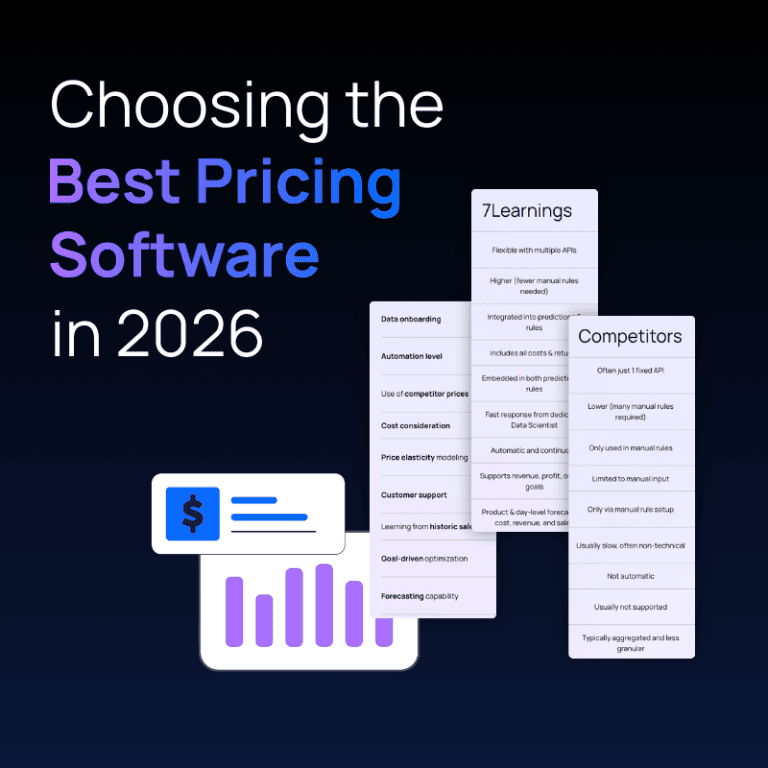
Criterion | 7Learnings | Quicklizard | Omnia Retail | Symson | Buynomics | Revionics |
Decision architecture | Prediction-first ML; rules as guardrails | AI-assisted, execution-led with rules | Rule-based decision tree + monitoring | Hybrid AI + business rules | Simulation-first (Virtual Shoppers) | AI/science with legacy rule roots |
Model inputs & continuous learning | Retrains daily on sales, costs, returns, competitor data | Market and competitor feeds | In-house competitor data + rules | ML on sales + competitor data | Trained on transactions + surveys | Retrains weekly/on demand |
Price elasticity modelling | SKU-level, embedded | Limited depth | Limited (rule-led) | Predicts per-product elasticity | Willingness-to-pay modelling | Core to price science |
Consideration of all costs | Returns, shipping, overhead in profit | Cost/margin via rules | Margin floors via rules | Cost-based strategies | Net P&L incl. trade terms | Margin and promo costs |
Goal-driven optimization | Set target, optimizer finds prices | Strategy-based; may need add-ons | Rule/strategy-driven | Objectives via Strategy Builder | Prescriptive scenarios (pre-launch) | KPI-based optimization |
Granular forecasting | Product- and day-level; what-if | Aggregated; execution focus | Reporting; limited forward view | Scenario impact on margin/revenue | Scenario forecasts pre-execution | Item-level forecasting |
Data onboarding & integration | Deploy in 3-4 months. Full integration & ROI in 3 -4 months. Setup 2-4 weeks of IT effort | Multi-channel APIs | ERP / PIM; fast onboarding | ERP/e-commerce; plug-and-play | ~3-month onboarding | Enterprise; more setup |
Support model | Dedicated data scientist | Standard support | Customer success managers | Consultant support | Dedicated success manager | Pricing strategists/consulting |
7Learnings
7Learnings is a prediction-first pricing platform. Instead of asking teams to write and maintain pricing rules, it works the way Google Maps does: you set the destination, say season profit or a sell-through target, and the machine learning models forecast the outcome of each price and markdown before it goes live, then set prices to reach the goal.
The platform also forecasts at the product and day level, factors returns and shipping into every recommendation, and keeps learning from your sales history so accuracy improves without manual recalibration.
For fashion specifically, 7Learnings models demand for private-label and variant-heavy ranges where there is no competitor price to copy, and optimizes profit across the full season rather than just clearing stock quickly.
GALERIA, the German department store, saw a 230% revenue increase and a 50% margin uplift with ROI inside two months across an assortment of more than two million SKUs (7Learnings case study). Optimization runs on large catalogues finish in around two minutes, against the roughly six-hour cycle typical of broad enterprise suites such as BlueYonder.
- Pros: prediction-first architecture; product- and day-level forecasting; goal-driven optimization; fashion-specific depth on variants, private label, and seasonal lifecycle; SOC 2 Type II and ISO/IEC 27001 certified.
- Cons: newer to the US market, with no public US customers yet (Altitude Sports in Canada is the nearest reference); best suited to teams ready to move off manual rules rather than those who want to set every price by hand.
Quicklizard
Quicklizard pairs AI-assisted decision-making with pricing rules, and is used mainly by retailers that need frequent price updates across multiple digital and physical sales channels. The platform’s strength lies in the speed and flexibility of price execution rather than in deep demand forecasting, and it lets teams test strategies and review their outcomes.
Quicklizard’s public case studies sit in beauty (Sephora) and electronics (Elkjøp) rather than apparel, so its fashion-specific track record is thinner than its omnichannel execution credentials suggest.
- Pros: fast, flexible price execution across channels; strong multi-channel and omnichannel coverage.
- Cons: limited depth in forecasting and elasticity modelling; may need supplementary tooling for goal-based optimization.
Omnia Retail
Omnia Retail is a European market leader in competitor monitoring and rule-based dynamic pricing, built around a transparent pricing decision tree and very large-scale daily price collection.
The platform has a dedicated fashion offering that addresses seasonal clearance, markdown pricing, and size-based pricing complexity, so its fashion fit is genuine. Omnia Retail’s core remains rule-based and reactive, aligning prices with the market rather than forecasting demand in advance.
- Pros: strong competitor monitoring and in-house market data; good fit where the goal is keeping prices aligned to the market with transparent rules.
- Cons: rule-based core rather than predictive; responds to the market rather than modelling demand in advance.
Symson
Symson is a Rotterdam-based, mid-market pricing platform built around its “Hyperlearning” method: pairing machine learning with a Strategy Builder of configurable strategies and business rules, plus daily competitor monitoring.
The platform predicts elasticity per product, lets teams run scenarios before applying changes, and keeps a human in the loop with explainable logic. Symson’s competitor matching uses image recognition, which suits categories like fashion where listings vary. However, there is no public fashion case study, so treat its fashion fit as unproven for now.
- Pros: flexible multi-strategy builder with business rules; strong competitor monitoring; explainable, human-in-the-loop AI.
- Cons: hybrid rules-and-monitoring approach rather than goal-solving prediction; mid-market focus with no disclosed North American presence.
Buynomics
Buynomics is a revenue management platform built on its “Virtual Shoppers” agent-based simulation, which models shopper behaviour to test price, promotion, and portfolio scenarios before execution.
The platform’s heritage is in consumer goods and manufacturing, with named customers including Lindt & Sprüngli and Dr. Oetker, and its published case studies are in food, confectionery, and skincare rather than fashion. It is strongest as a pre-execution what-if tool for revenue teams.
- Pros: strong scenario modelling and visualization via Virtual Shoppers; useful for pre-execution strategy testing.
- Cons: less suited to teams that want streamlined, fully automated optimization against live profit or revenue targets; consumer-goods orientation rather than fashion.
Revionics
Revionics (an Aptos Company) is a long-established, science-based pricing platform strong in base, promotional, and markdown pricing for large assortments. Its customer base is concentrated in grocery, mass, convenience, and pharmacy retail, so its fashion-specific capabilities are limited.
The platform is a capable option for complex, high-volume environments, though its rule-based legacy can mean more setup and consulting to reach its AI features.
- Pros: strong markdown and promotional pricing for large assortments; established presence in mass retail; dedicated pricing strategists.
- Cons: legacy rule-based foundation; heavier setup and consulting to unlock full AI capability; weaker fashion-specific track record.
Questions to ask before you buy
Use these criteria as a short list of questions worth putting to any vendor in a demo. The answers separate a fashion-ready platform from one that only presents well. See our companion piece on selecting an AI pricing tool for a complete evaluation framework.
- Does the platform forecast the outcome of a price or markdown before it goes live, or only report on it afterward? A strong answer shows projected profit, revenue, and sell-through for a scenario before you publish. A weak one is a dashboard of past performance with no forward view.
- Can it model elasticity at the SKU level for products with no competitor price, like private label? A strong vendor builds demand and elasticity from your own sales history. A weak one depends on competitor feeds, so private-label items quietly fall back to manual rules.
- Can I set a commercial goal and have the system find the prices, or do I hand-build the rules? A strong answer is goal-driven: you set season profit or sell-through, and the optimizer works out the path. A weak one puts the burden of rule-writing and maintenance back on your team.
- How does it handle the full season, from first markdown to clearance, rather than one markdown at a time? A strong platform optimizes profit across the whole lifecycle. A weak one issues isolated discount recommendations that can clear stock while eroding season margin.
- Which costs are in the profit calculation: returns, shipping, and overhead, or only gross margin? A strong answer accounts for net contribution, which matters most in return-heavy fashion. A weak one calls a price “optimized” on gross margin alone.
- What is the realistic time to first ROI, and what is the integration lift on our side? A strong vendor talks in weeks to a couple of months with flexible onboarding. A weak one describes a multi-quarter implementation against a single rigid integration.
- Can we see why the platform recommends a given price, and who supports us day to day? A strong answer is explainable price guidance plus a named specialist who understands pricing. A weak one is a black box and a general support queue.
- How is our pricing and transaction data secured and isolated, and what certifications back that up? A strong vendor names independent certifications such as SOC 2 Type II and ISO/IEC 27001 and can explain data isolation. A weak one offers vague assurances with no third-party audit.
Making the right call on AI pricing software for fashion
If a vendor’s demo cannot show you how it forecasts the outcome of a price or markdown before it goes live, models elasticity for products with no competitor price, and optimizes toward the goal you set, it is not ready for fashion retail at scale, whatever the dashboard looks like.
The platforms that clear that bar are the ones worth a pilot. Outletcity, an off-price fashion retailer, used 7Learnings to lift profit 26% and revenue 11% on its end-of-season sell-off (7Learnings case study), the kind of result that shows up when pricing is optimized across the season rather than reacted to week by week.
If your current tool can only tell you how a markdown performed after the fact, that is the gap worth closing. 7Learnings forecasts the profit, revenue, and sell-through impact of every price and markdown across your assortment before it goes live, including for private-label and variant-heavy ranges, so you can move off manual rules without giving up control.
Book a demo and put it against your own fashion assortment.
Frequently asked questions about AI pricing software for fashion retailers
What’s the difference between AI pricing software and dynamic pricing software?
Dynamic pricing software changes prices in response to signals like competitor moves or demand, often using rules you configure. AI pricing software goes further by forecasting the outcome of a price change before it happens and optimizing toward a goal you set, such as season profit or sell-through.
In practice, many “dynamic pricing” tools are rule-based and reactive, while AI or predictive platforms model demand and simulate results in advance. For fashion, that forward view matters most where there is no competitor price to react to.
How long does it take to see ROI from AI pricing software?
It depends on the platform and how clean your data is, but modern AI pricing tools are designed to show value in weeks to a few months rather than the year-long timelines of legacy enterprise suites.
7Learnings reports first ROI within about a month on flexible data onboarding, and GALERIA reached ROI inside two months across more than two million SKUs (7Learnings case study). You can estimate your own range with the 7Learnings profit uplift calculator.
Which AI pricing software is best for fashion retailers managing end-of-season markdowns?
The best fit for end-of-season markdowns is a platform that optimizes profit across the whole season rather than treating each markdown as a standalone discount. Look for SKU- and day-level forecasting, elasticity modelling for private-label items, and the ability to set a sell-through or profit goal and have the system find the markdown path.
7Learnings is built around this season-long view; Omnia and Revionics offer markdown tooling but lean toward rule-based. Match the choice to how variant-heavy and private-label your range is.
Can AI pricing software handle products with no competitor price data?
Yes, but only if it models demand from your own sales history rather than depending on competitor feeds. This is common in fashion, where private-label and exclusive lines have no market price to match.
Platforms that build SKU-level elasticity from your transaction data can price these items on predicted demand and target margin, whereas rules- or monitoring-led tools tend to fall back to manual input. It is one of the most useful things to test in a demo.