
Increase your profit by 15% with Predictive Pricing

7Learnings forecasts how price changes will affect your profit, revenue, sales, and stock levels for all products, then sets the optimal price to hit your revenue and profit targets.

Smiling professional man with crossed arms in an office setting.

The value we bring to your business

Price optimization software should tell you what a price will do before you publish it. 7Learnings applies predictive analytics to your historical sales data, product attributes, stock levels, and marketing data, forecasts demand and price elasticity across your SKUs, and retrains daily with new data.

Proven profit uplift

Our price optimization delivers an average 15% increase in profit as validated by rigorous A/B testing. Our pricing optimizer predicts how different price points affect demand and profitability, helping you find the prices that deliver better commercial outcomes.

Example: Identify which price points maximize profit for each product by comparing predicted demand and margin across different pricing scenarios.

Massive efficiency gain

We enable you to automate pricing decisions across your entire assortment, reducing manual workload by up to 80%. Instead of manually analyzing and adjusting prices, your team can focus on strategy while the optimizer handles the large-scale complexity.

Example: Reprice your entire assortment based on changing demand and business objectives, without needing to manually calculae and update prices.

Continuous improvement

Keep pricing decisions up to date with self-learning machine learning models that continuously adapt to changing demand and market conditions, with automated updates 7 days a week.

Example: Automatically adjust prices as products move through their lifecycle, from launch and peak demand to end-of-season markdowns.

Enterprise support

Get dedicated support from data scientists who guide data integration and continuously help optimize your forecasts. From getting your data ready to improving forecast quality, you have expert support to make your pricing optimization work for your business.

Example: Work with our data scientists to refine your demand forecasts and ensure your pricing setup reflects your assortment and business requirements.

Granular precision

Forecast the impact of different price points on profit, revenue, and sales at product level before implementing a change. Our elasticity models work across your entire assortment, including products with limited sales history, to help you make informed pricing decisions.

Example: Compare the projected outcomes of a 20% site-wide voucher against targeted discounts on slow-moving products before committing to a promotional strategy.

The price optimization process: From data to decision

Automated data input

Connect your transaction history, product attributes and stock data, with optional marketing and competitor data. The 7Learnings data science team handles data preparation, and the connection runs automatically from then on. Data handling is covered by our security and compliance standards.
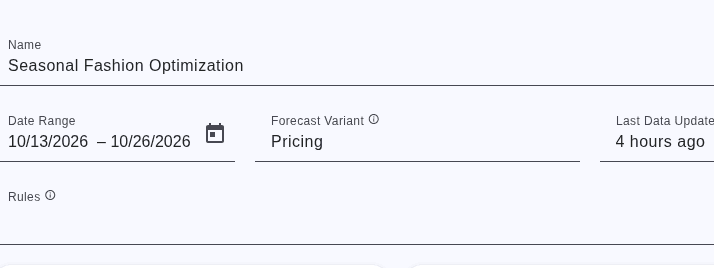
Dashboard header for Seasonal Fashion Optimization showing date and forecast.

Define the scope

Choose the products, categories, markets, channels or seasons you want to optimize. Use the attributes available in your data to define the scope of each pricing strategy and apply different approaches where your business needs them.
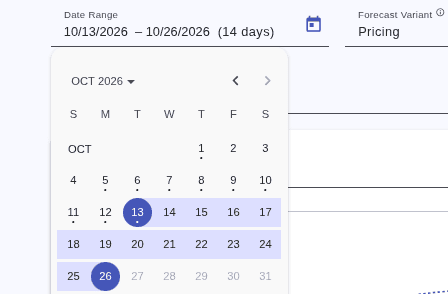
Calendar date picker showing a selected 14-day range in October 2026.

Rule selection

Define the commercial constraints your pricing recommendations must respect. Apply rules such as minimum margin floors, discount caps and limits on price changes to ensure recommendations stay within your business requirements.
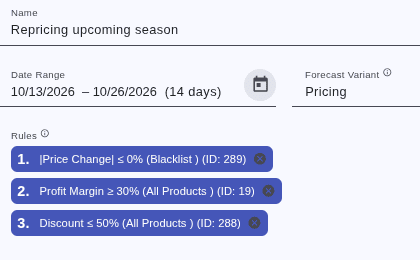
Interface for configuring repricing rules for an upcoming season.

Target selection

Choose the commercial objective for each pricing scope. Whether you want to maximize profit, grow revenue, protect margins or increase sell-through, 7Learnings uses your targets to determine which pricing decisions are most likely to deliver the desired outcome.
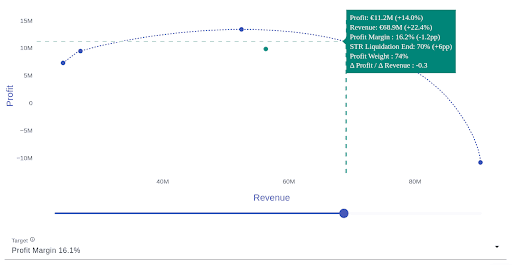
Profit versus revenue scatter plot with a downward-sloping trend curve.

Optimization review

Review product-level demand forecasts and optimizations and see how different prices are predicted to affect profit, revenue, sales and inventory. Compare alternative pricing strategies side by side before committing to a change, with visibility into the expected outcomes of each approach.
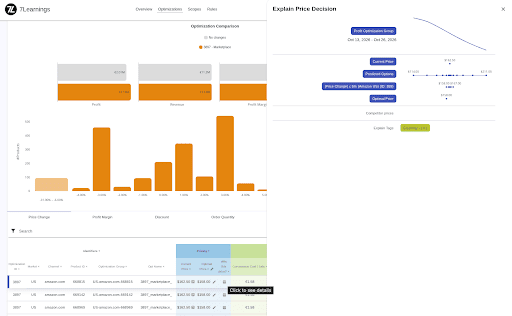
Dashboard showing price optimization analytics and product pricing tables.

Activate and monitor prices

Approve your recommendations and push them to your shop system, or export them at SKU or variant level. Schedule uploads with an email approval step where supported, then compare actual performance with forecasts to monitor accuracy and adoption over time. Each recommendation provides insight into the factors behind the suggested price, including price elasticity and stock levels.
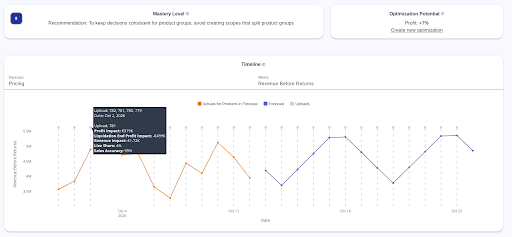

Analytics dashboard showing revenue timeline, forecast, and optimization potential.

Both are forms of dynamic pricing: rule-based pricing sets prices from conditions you define in advance, while predictive pricing forecasts what each price will do to demand and then chooses. The table below compares the two across 11 criteria, and the full comparison guide covers where each approach fits.

Rule-based

Pricing

Dynamic pricing that sets prices based on a predefined set of rules.

Predictive

Pricing

Dynamic pricing that adjusts prices based on predicted outcomes.

Supports rule based pricing
Utilization of competitor prices
Learns automatically from past price changes
Algorithm considers all relevant data features (e.g. transactions, weather, seasonality)
Utilizes price elasticity
Predicts price change impact on KPIs
Optimal prices for private label products & bundles
Channel specific pricing (e.g. country)
Long-tail pricing & initial pricing
Goal driven steering across the assortment
Considers and cross-optimizes marketing decisions (e.g. coupons, promotions or performance marketing )

The impact we deliver

Retailers working with 7Learnings increase profit by 15% on average, measured against a control group rather than before-and-after. The results below are from European retailers, verified by AB test and published in full.

Fashion brand Petrol Industries

By optimizing prices across online marketplaces with 7Learnings and ChannelEngine, Petrol Industries achieved a 61% profit uplift.

Read the Petrol Industries case study →

Fashion retailer Outletcity

By using predictive pricing to improve profitability and manage end-of-season sales, Outletcity achieved a 26% profit uplift while reducing the complexity and workload of setting prices.

Read the Outletcity case study →

Home & living retailer Westwing

By using predictive pricing to steer towards profit maximization, Westwing achieved a significant profit increase on the assortment included in its A/B test, while halving operational time.

Read the Westwing case study →

Online pharmacy apo.com

By implementing machine-learning-based price optimization, apo.com achieved a double-digit profit uplift alongside a single-digit revenue increase, while simplifying its pricing processes.

Read the apo.com case study →

Free 30-min demo

Start making better commercial decisions

15%+

profit increase

80%

less manual work

20x

faster optimization

Man with brown hair wearing a red and white trucker hat.
Felix Hoffmann
Retail Optimization Expert

“We shouldn’t decide based on gut feeling, we should decide based on what we predict will happen.”

Prefer to be contacted? Send us a message ↓

FAQs

You have questions? We have answers.

What is price optimization software?

Price optimization software calculates the prices that best meet a commercial goal, using data rather than fixed rules. Price optimization models estimate how customer behavior responds to price, factor in how price-sensitive each product is alongside stock levels, seasonality, costs, and channel, and recommend prices accordingly.

Rule-based tools apply conditions you set in advance. Predictive tools forecast the outcome of a price first, then choose it. The difference shows up most on large assortments, where the number of interacting decisions is beyond what a rule set can express.

7Learnings trains a machine learning model on your transaction history, product attributes, and stock data, and retrains it daily. The model predicts demand and elasticity at each candidate price for every product, including items with little price history, by learning across your assortment.

You set a commercial target and any rules the prices must respect. The optimizer returns recommended prices with a forecast of their effect on profit, revenue, sales, and stock. You review and approve them before anything goes live, so pricing moves from building lists by hand to approving recommendations.

You see the outcome before you commit. Rule-based pricing applies a condition and measures the result afterwards, which makes markdowns reactive and often late.

Predictive pricing forecasts the effect of each price first, so you compare strategies, steer to a specific target, hold competitive positioning where it matters, and price products that have no competitor reference at all. Rules still have a place as guardrails, setting the margin floors and discount caps the optimizer has to work within.

No. Implementation is a data connection rather than a platform migration, and our team handles data preparation. Most clients run a three-month proof of concept measured as an AB test, and the tech lift on your side is light enough that pricing and commercial teams, not IT, own the project day to day.

Most clients see measurable improvement in profit and sales within the first few weeks of going live, and a standard three-month proof of concept is long enough to quantify the uplift against a control group. If you want an estimate before you start, the profit uplift calculator gives you a figure based on your own numbers.