



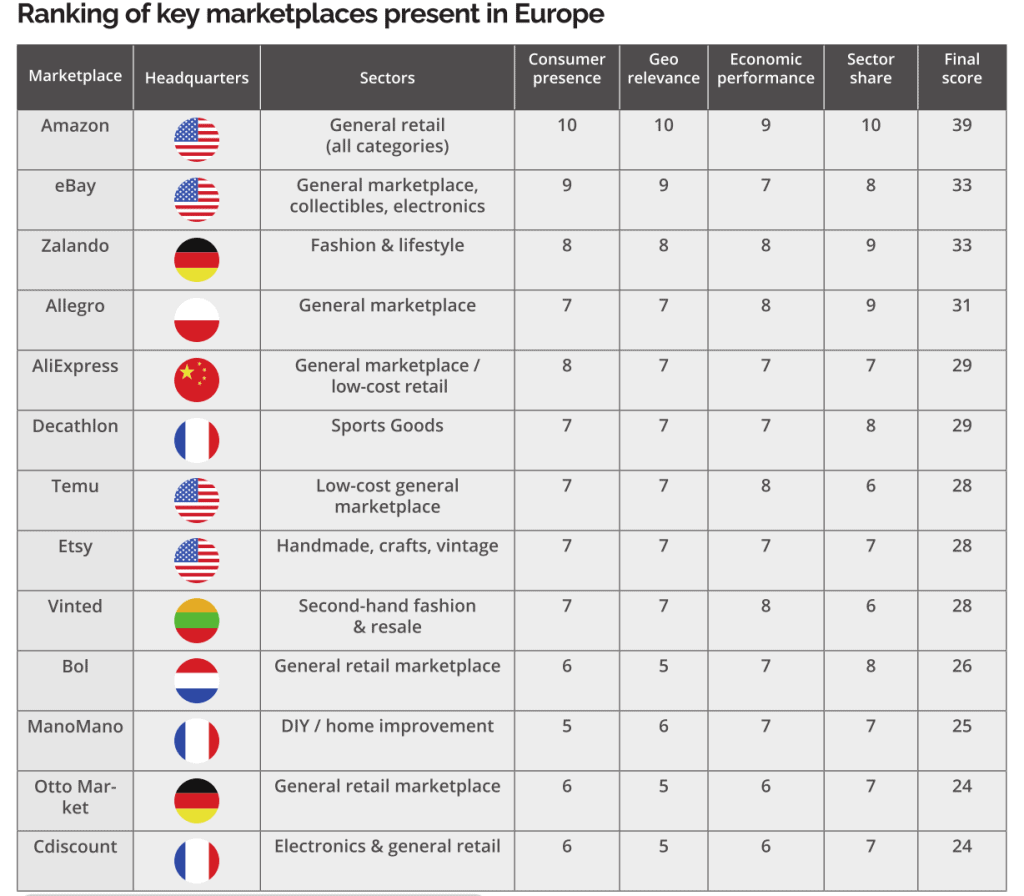
European commerce continues to be dominated by marketplaces, as shown in the recent RetailX Marketplaces Report 2026 sponsored by 7Learnings. In Western Europe, marketplaces now account for over 40% of total retail ecommerce, rising to almost half in countries like Austria. Additionally, among the top 1,000 European retailers, marketplaces represent just 12% of the sites but command 53% of all consumer web traffic. This dominance is further amplified by loyalty schemes; customers who subscribe to a marketplace delivery pass tend to spend around four times as much as non-subscribers.
The caveat here is that although competition is intensifying between global giants, regional champions, and niche disrupters, driving volume is no longer the main challenge. For brands and retailers in 2026, the ability to turn marketplace traffic into sustainable growth presents the biggest hurdle.
In partnership with RetailX, 7Learnings sponsored the Marketplaces Report 2026 to analyze the shifts in consumer behavior, technology, and platform dynamics. Here are the primary trends shaping European marketplace strategy this year, and what they mean for your company’s results.
The growth of retailer-run marketplaces & ecosystems
European retailers are still working towards methods of competing against the enormous reach and penetration of platforms like Amazon and eBay. One way of doing this is a move from linear inventory models to curated platform models. Here are some examples:
- Expanding catalogs without inventory risk: Retailers like Decathlon, Otto, Cdiscount, and Kingfisher are inviting third-party merchants onto their sites, expanding their product catalogs from thousands of SKUs to millions without carrying inventory liability.
- Leveraging scale & reach: Kaufland is using its significant brand presence to open a marketplace spanning seven European countries (including Germany, Poland, and France), reaching a potential audience of 140 million consumers.
- Omni-channel initiatives: Kingfisher’s Marketplace Click and Collect at B&Q stores works to bridge the gap between digital marketplaces and physical retail. According to David Jaffe, head of marketplace growth at Kingfisher, they view this as a competitive advantage that pure e-commerce sites cannot replicate.
- Cross-collaboration: Decathlon is taking its marketplace ecosystem into physical environments by leasing retail space within MediaMarktSaturn stores in Germany.
These category-specific retailer marketplaces present an interesting opportunity for brand sellers, giving them access to an engaged, loyal customer base with the additional benefit of leveraging the retailer’s established brand trust.
Second-hand and refurbished goods are booming
Consumers in Western Europe continue to show a strong interest in circular commerce (second-hand and refurbished goods). It now represents a major area of growth.
- Strong projected growth: Analysts believe the European second-hand market will reach €116.1 billion by 2035, growing at an 11.7% CAGR. Today, second-hand and refurbished goods account for almost 10% of total marketplace sales in Europe.
- Demographics predict shopping behaviors: The second-hand and refurbished goods market is strongest with consumers under 34 across the UK, Germany, Spain, France, and Italy, with 85% purchasing these types of goods online. This number falls to 55% for consumers over the age of 55. In France and Spain, youth adoption hits 91% and 89%, respectively.
- Outpacing traditional retail: Although much of the discourse today focuses on fast fashion, data shows that platforms like Vinted (€10.8 billion GMV) are directly outcompeting fast fashion companies. In France, Vinted is the largest clothing retailer by volume, surpassing the likes of Amazon, Shein, and Decathlon.
- Marketplace reactions: Traditional marketplaces have been taking note. Amazon’s second-hand product sales now exceed €2 billion across Europe and the UK. eBay has also recently made acquisitions of the youth-focused resale app Depop and Norwegian fashion marketplace Tise to capture Gen Z market.
- Trust & warranties: A major driver of the growth of these platforms is the removal of consumer risk. For example, BackMarket, a refurbished electronics marketplace, builds trust by offering 30-day returns, a one-year warranty, and multi-point quality inspections on all items.
Social media driving in-feed conversions
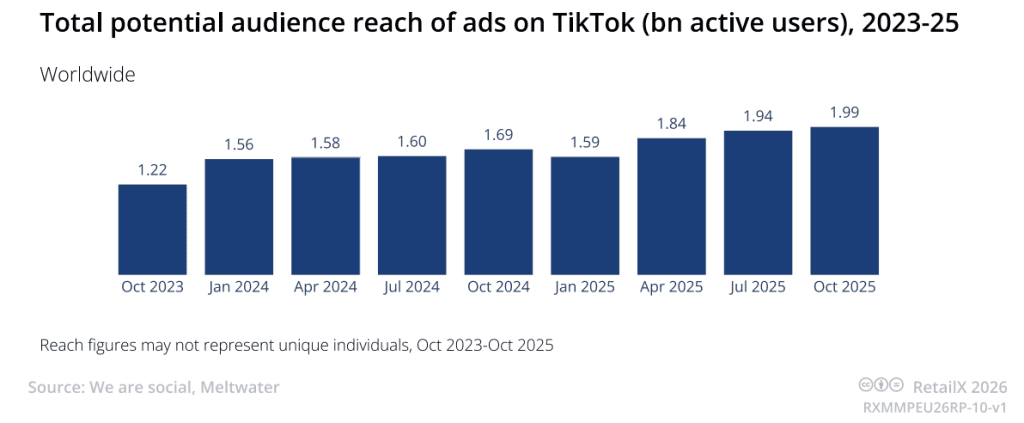
Social discovery and marketplace transactional checkout are now almost indistinguishable, driven by the massive amount of time consumers spend on social apps. Consumers average 18.5 hours each week on social media.
- Instant purchases: TikTok Shop is the most prominent example here; users discover products via live video and check out entirely within the app. As a result, expectations are high, with users seeking seller responses within 1.1 hours, compared to 4.2 hours on Amazon.
- Curated feeds: Carey Pearson, head of brand at Wayfair, notes that social platforms allow retailers to show consumers different possibilities (e.g., velvet, bouclé, or corduroy) rather than just fulfilling a direct search for a “grey sofa”.
- Real people’s opinions: Bol reports that content using real people and creators converts at a much higher rate and drives significantly increased engagement when compared with polished studio product shots. Facebook remains strong for off-site traffic, accounting for 75% of web traffic leaving social platforms for a third-party site.
Agentic AI as a storefront and buyer
Search is moving away from keyword-based query boxes toward conversational, natural-language AI assistants. Up to €310 billion worth of transactions in Europe will be AI-assisted within the next ten years.
- High adoption and increased conversion: Rufus, Amazon’s original AI assistant, was used by 300 million customers in 2025, representing a 210% YoY increase. However, despite data showing shoppers using Rufus prompts were over 60% more likely to convert, Amazon shelved the project in favor of “Alexa for Shopping”. This new iteration connects directly to the main search bar, blending product catalog data with a user’s Alexa-powered personalization and shopping history to create a conversational storefront.
- Gen Z reliance: Rithum data has shown 64% Gen Z shoppers will act on AI product recommendations even without verifying on the brand’s own site.
- Seller automation: marketplace backends are also being automated by AI. An example is eBay’s “magic listing” tool, which uses AI to auto-generate titles and descriptions from a seller’s uploaded photograph.
- Product feed requirements: AI agents evaluate product attributes horizontally (analyzing lifestyle context, reviews, and specific specs), as such, product catalog feeds must now include structured, context-rich storytelling. A paragraph explaining how a product is used teaches a Large Language Model better than a few isolated keywords.
Trust could become a major barrier to AI-powered shopping
The shift towards AI-assisted shopping is not only a question of technology and adoption. Trust remains a significant hurdle.
RetailX found that 41% of consumers do not yet trust a single organisation to provide an autonomous AI shopping agent. This suggests that while consumers may increasingly use AI to discover and evaluate products, retailers and marketplaces still need to earn confidence around recommendations, product information and purchasing decisions.
For brands and retailers, this makes the quality and accuracy of product data increasingly important. As AI agents play a larger role in filtering products for consumers, being visible may depend not only on traditional search optimisation, but on whether product information is sufficiently accurate, structured and context-rich for AI systems to evaluate.
Visibility costs are increasing
While retail media networks (RMNs) have become a high-margin business for marketplaces, they represent an increasing operational cost for sellers. By using zero-party data, marketplaces are serving highly targeted promotional offers directly into the shopping journey.
- Sustained ad growth: Amazon’s retail media ad revenue surpassed €63 billion in 2025, with Q4 year-on-year growth reaching 22%.
- Marketplace ad revenue surging: Other platforms are experiencing similar booms. Otto Advertising grew by 49% in 2025, and Allegro’s advertising revenue grew by 32% in Q3, fueled by AI-powered ads that generated a 16% larger click-through ratio.
- Margin loss for sellers: Sponsored placements now dominate organic search results on major platforms. For many marketplace sellers, platform commissions combined with advertising spend now exceed 50% of the item’s total revenue. Every euro spent climbing the rankings is a euro off the margin of the final sale.
Chinese marketplaces & localized logistics
Chinese marketplaces are gaining significant ground in Europe. What started as simple low-cost shipping models is now sophisticated, localized logistics operations.
- Economic impact: In Germany alone, ultra-low-cost marketplaces Temu and Shein ship roughly 460,000 parcels daily. Research estimates these two platforms cost the German retail trade €2.5 billion in lost sales annually.
- Cross-border dominance: Temu now ranks second in European cross-border trade (behind only Amazon), with AliExpress in fourth and Shein in tenth.
- Localized logistic infrastructure: These platforms are heavily upgrading their European fulfillment. Shein partnered with THG Fulfil in the UK to offer local sellers late-night cut-offs for next-day delivery. JD.com launched its JoyBuy marketplace across Europe, offering same-day delivery on orders over €29 using its own warehouses and last-mile delivery service.
- Regulatory defenses: Of course, all of this has not gone unnoticed. As of July 1, 2026, the EU officially abolished the €150 de minimis customs exemption, replacing it with a flat €3 duty per product category on all low-value shipments from outside the bloc. Furthermore, a sweeping EU Customs Reform, which introduces additional package handling fees in November 2026 and shifts legal product safety liability directly onto the platforms, aims to close the loopholes that previously gave ultra-low-cost Chinese marketplaces an unfair advantage over domestic retailers.
Read on: How European retailers can compete with Shein and Temu
Marketplace profitability: The 7Learnings perspective
“If you sell on marketplaces, you’ve already solved the problem that defined the last decade: getting found. The new problem is that growth and profit have become two different things.”
— Felix Hoffmann, CEO & Co-Founder, 7Learnings
This report shows three critical areas that are affecting profitability for marketplace sellers:
- Ad Spend as a tax on sales: Winning top placements requires bidding on sponsored ads, turning visibility into a direct variable cost per unit sold.
- Aggressive price anchoring: Ultra-low-cost platforms have trained comparison tools and shoppers to anchor on the lowest price. Reactive, rule-based discounting simply leads to a margin-destroying race to the bottom.
- AI agents evaluating value: When an AI assistant evaluates options for a consumer, it filters products based on live price, delivery, and stock context in real time. If your price isn’t optimized the moment the AI agent queries the catalog, your product never makes the shortlist.
The Solution: Predictive, AI-supported decision making
To stay profitable and grow, pricing, ad budgets, and stock levels need to be managed and optimized in unison. A weekly pricing meeting cannot keep pace with an environment where competitor prices, demand, stock, and ad costs move by the hour. Static pricing rules (e.g., matching a competitor’s price regardless of your own ad spend) ignore the relationship between price, demand, and profit across the full range.
The retailers consistently earning high net margins on marketplaces treat pricing as a predictive, always-on discipline:
- Model outcomes first: Predict the precise demand and net profit impact of a price change before pushing it live.
- Unify decisions: Connect pricing, inventory levels, and retail media ad spend into a single automated engine.
- Protect margin where possible: Automatically compete aggressively on price only where it actually guarantees winning the sale, while rigorously protecting margin on items with lower price sensitivity or where profit margins already exceed your baseline targets.
How Petrol Industries increased profit by 61% on marketplaces
The difference between rule-based repricing and predictive pricing is best illustrated by results. Petrol Industries, a leading European apparel brand operating a high-volume multi-channel model across major online marketplaces like Zalando and Bol.com, partnered with 7Learnings (facilitated through a direct integration with ChannelEngine) to optimize prices across these various marketplaces.
Previously, Petrol Industries relied on static, rule-based pricing. During clearance periods, this resulted in broad price-slashing that failed to calculate product-level profitability or account for platform-specific commission brackets and high return rates. The 7Learnings engine modeled daily demand and calculated price-elasticity for each individual SKU, factoring in hidden transactional costs like returns and commissions.
The results of automating this data pipeline and moving away from unprofitable price matching were immediate:
- +61% increase in profit
- +37% increase in margin
- +18% increase in revenue
You can read the full case study here.
Turn marketplace growth into profitable growth
The marketplace landscape is becoming more dynamic, competitive and interconnected. Pricing, advertising spend, demand and inventory can all influence the profitability of a sale, making it increasingly difficult to optimise each decision in isolation.
7Learnings helps retailers use predictive, AI-supported decision making to understand the relationship between these factors and make more informed decisions about pricing and profitability.
Want to see how 7Learnings can help your business optimise marketplace profitability? Get in touch with us.
Complete 42-Page data & analysis
For deeper category benchmarks, consumer survey breakdowns, and granular marketplace profiles covering Amazon, Zalando, eBay, Vinted, Decathlon, and TikTok Shop, download the full comprehensive report.