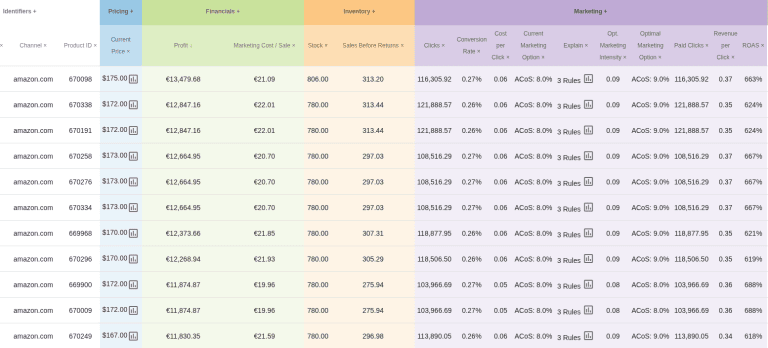
7Learnings predicts the profit and revenue impact of changes to marketing campaigns at the product level.
Based on your growth ambitions, we optimize the allocation of products across ad groups with specific ROAS/CPC targets, making your marketing campaign more efficient.
We use your full historical marketing and transaction data to deliver predictions that give you an edge over competitors who fail to use all their data.
Example: By analyzing catalog-wide conversion patterns, 7Learnings accurately forecasts demand for brand-new or long-tail SKUs, even those with zero prior sales history.
We optimize Profit after Market Cost, considering predicted returns, logistic costs, tariffs, stock-outs, commission costs, conversion rates, and all other relevant cost factors on the product level.
Example: Automatically adjust ad spend and reorder volumes on items with high return rates, preventing hidden fulfillment and reverse-logistics costs.

We predict the impact of price changes on conversion and consider this in your campaign management on the product level.
Example: When a price drop boosts a product's conversion rate, 7Learnings automatically reduces ad bids to protect your Profit After Marketing (PAM) while securing sales.
Align your marketing decisions with product ordering limitations to avoid out of stock situations and high overstock.
Example: Automatically scale back ad spend on products predicted to stock out within two weeks, preserving ad dollars for SKUs with healthy inventory buffers.
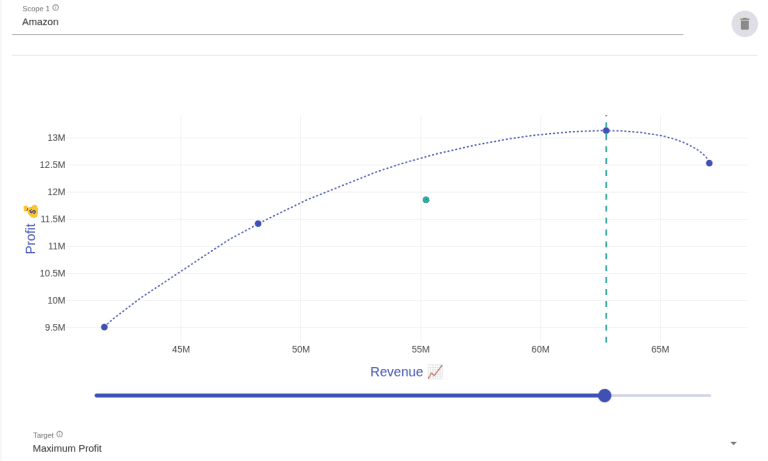
You can optimize towards your profit and revenue targets and get an accurate forecast for marketing cost per product.
Example: Set a target for 5% revenue growth next week, and 7Learnings will automatically reallocate campaign bids across SKUs to hit that target while maximizing net profit.


By implementing product-specific Cost per Click (CPC) steering, a large European fashion brand achieved a 27% increase in profit and a 34% increase in revenue, alongside a 7% conversion uplift.
Using a single Google Shopping campaign with differentiated ROAS targets, a leading fashion retailer saw a 52% profit surge, a 53% revenue boost, and a massive 180% increase in new customers.
By optimizing marketing and pricing together across all their traffic channels, a leading furniture retailer drove a 19% profit increase, 40% more revenue, and a 14% higher revenue per click.
Implementing differentiated CPC steering by product enabled a leading pharmacy retailer to realize a 36% profit uplift, a 26% revenue increase, and an 8% boost in overall sales.
Book a demo with one of our experts and learn how our software can grow your profit and revenue.
7Learnings uses predictive machine learning models to analyze daily, product-level marketing data, including clicks, conversions, spend, stock levels, competitor pricing, and contribution margins. By modeling demand elasticity for every SKU, the software predicts how bid and target adjustments impact total sales, conversion rates, and gross margin. It then automates target and budget adjustments to align directly with your KPI targets, whether you are steering for profit maximization, revenue growth, or inventory clearance.
While price and paid media are usually managed separately, both directly impact conversion rate and ROAS. Cross-marketing optimization evaluates pricing strategy and ad spend in a single unified model. When product prices change, the engine automatically adjusts campaign tROAS or bid targets to reflect the new conversion probability and product margin, preventing wasted ad spend on low-margin SKUs and scaling spend where margins expand.
For Amazon Ads, 7Learnings ingests ASIN-level clicks, conversions, ad spend, Buy Box status, and campaign structures via direct API connections to Amazon Ads and Amazon Selling Partner API (SP-API).
A hybrid setup combining Performance Max (PMax) and Standard Shopping typically yields the best results. Standard Shopping allows granular, ad-group-level tROAS or bid steering per product cluster, while PMax captures incremental reach across Search, Display, and YouTube.
The engine ingests daily, SKU-level historical performance data, including impressions, clicks, conversions, spend, and structural campaign settings. Integration is automated via native APIs connecting to Google Ads, Google Analytics (GA4), and your product feed or shop backend.
If you run exclusively on Performance Max, the software sets up a tiered campaign structure with 5 to 10 PMax campaigns operating at distinct tROAS targets. 7Learnings dynamically routes SKUs between these campaigns based on real-time margin, conversion probability, and inventory availability to maximize account-level efficiency.
For Standard Shopping-only accounts, the engine builds a multi-tier structure with 5 to 10 ad groups or campaigns featuring differentiated tROAS or tCPC targets. Products are continuously shifted across tiers based on predicted conversion performance, stock status, and profit contribution.